Electric Resistance Welding (ERW) is one of the most widely used metal joining technologies in modern manufacturing, especially where high-speed production, automation compatibility, and consistent weld quality are critical. For industries such as automotive, HVAC, appliance manufacturing, and heavy engineering, ERW provides a reliable and cost-efficient solution for joining sheet metals and components without filler materials.
At Heron Welder ,we specialize in advanced resistance welding systems, including spot, seam, projection welding, and fully automated production lines designed for OEMs and industrial manufacturers seeking precision and scalability.
What is Electric Resistance Welding?
Electric Resistance Welding is a thermo-electric process in which heat is generated by the electrical resistance of metals when current flows through them, combined with mechanical pressure to form a solid-state joint.
The workpieces themselves become part of the electrical circuit. When high current passes through the contact area, resistance generates localized heat, causing the metal interface to reach a plastic or molten state. Under pressure from electrodes, the materials fuse together to form a strong weld.
This process is widely recognized for:
- No filler material requirement
- Fast cycle times
- High repeatability in production lines
- Easy automation integration
Working Principle of Electric Resistance Welding
The fundamental principle of ERW is based on Joule heating (I²R effect):
- I (Current) flows through the workpieces
- R (Resistance) at the contact interface generates heat
- Heat causes localized melting or plastic deformation
- Pressure ensures metallurgical bonding
The electrodes not only conduct current but also apply controlled force and remove excess heat after welding.
This controlled combination of heat + pressure ensures strong and uniform joints, especially suitable for mass production environments.
Types of Electric Resistance Welding
Electric resistance welding includes several process variations, each suited for specific industrial applications:
1. Spot Welding
Spot welding is the most common ERW method where two copper electrodes press and heat localized points on overlapping sheets.
It is widely used in automotive body assembly and sheet metal fabrication due to its speed and simplicity.
2. Seam Welding
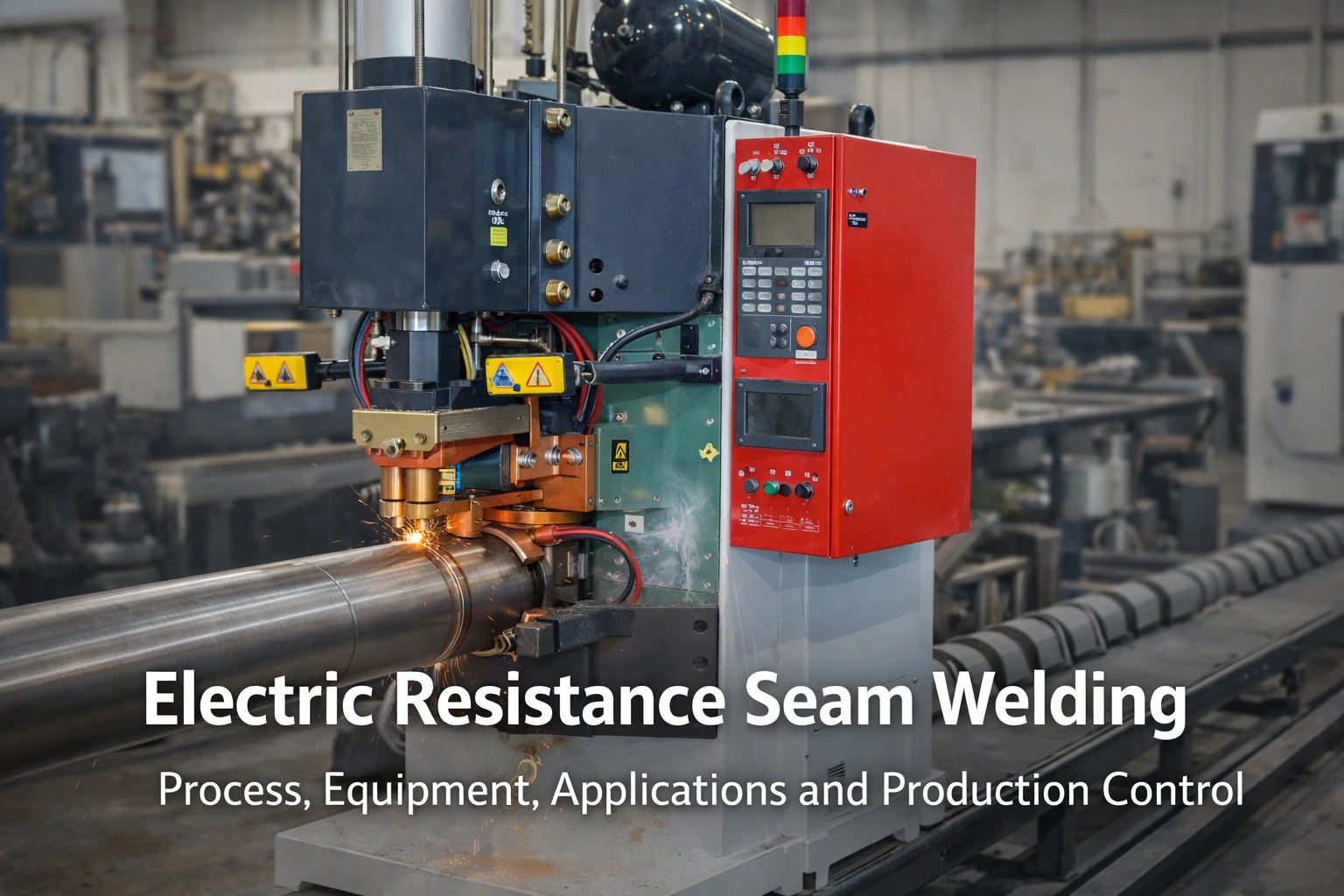
Seam welding uses rotating wheel electrodes to produce a continuous weld seam instead of individual spots. This makes it ideal for leak-proof joints.
It is commonly used in fuel tanks, HVAC ducts, and containers where airtight sealing is required.
3. Projection Welding
In projection welding, small raised projections on the workpiece concentrate current and heat, allowing multiple welds in a single operation.
This method is widely used for nuts, fasteners, and automotive components.
4. Flash Butt Welding (related ERW category)
Used for joining rods, wires, or rail sections by flashing and forging under pressure, often in heavy infrastructure applications.
Key Industrial Applications of ERW
Electric resistance welding plays a crucial role across multiple industries:
Automotive Manufacturing
- Car body panels
- Door frames
- Structural reinforcements
HVAC and Sheet Metal Industry
- Air ducts
- Industrial enclosures
- Ventilation systems
Electrical & Energy Sector
- Battery tabs
- Busbars
- Electrical cabinets
Heavy Engineering
- Steel furniture
- Metal containers
- Appliance housings
The ability to integrate ERW into automated production lines makes it a preferred choice for OEM-scale manufacturing.
Advantages of Electric Resistance Welding
ERW offers several engineering and production benefits:
- High production speed suitable for mass manufacturing
- No filler materials or flux required
- Automation-friendly process
- Consistent weld quality and repeatability
- Energy-efficient localized heating
- Suitable for thin sheet metals and assemblies
Industry studies show that resistance welding is especially efficient for high-volume production due to its fast cycle time and compatibility with automated systems.
Limitations of ERW (Engineering Considerations)
Despite its advantages, ERW has certain constraints:
- Requires high electrical power input
- Limited to specific material thickness ranges
- Electrode wear over time
- Initial equipment cost is relatively high
- Weld inspection can be challenging in some cases
These limitations are typically managed through advanced control systems and predictive maintenance strategies in modern production environments.
Best Practices for Industrial ERW Applications
To achieve stable weld quality and longer equipment life, engineers should consider:
1. Proper Electrode Selection
Use copper alloys optimized for conductivity and wear resistance.
2. Controlled Welding Parameters
- Current intensity
- Weld time
- Electrode force
- Cooling cycles
3. Material Preparation
Clean surfaces ensure better electrical contact and reduce defects.
4. Automation Integration
Modern ERW systems benefit greatly from PLC-controlled and servo-driven welding automation for consistency.
Heron Welder’s Expertise in Electric Resistance Welding
Heron Welder provides advanced resistance welding solutions designed for industrial-scale manufacturing, including:
- Spot welding machines
- Seam welding systems
- Projection welding units
- MFDC-based intelligent controllers
- Fully automated welding production lines
Our systems are engineered for:
- High precision manufacturing
- Stable long-term performance
- Integration with robotic automation
- Reduced operational downtime
For OEMs and manufacturing engineers, this means higher productivity with consistent weld quality across production cycles.
FAQs – Electric Resistance Welding
1. What metals can be welded using ERW?
ERW is commonly used for low-carbon steel, stainless steel, aluminum alloys, and coated sheet metals.
2. Is filler material required in electric resistance welding?
No, ERW does not require filler material or flux, making it a clean and efficient process.
3. What industries use resistance welding the most?
Automotive, HVAC, appliance manufacturing, electrical enclosures, and heavy fabrication industries.
4. How is ERW different from arc welding?
ERW uses electrical resistance and pressure, while arc welding uses a continuous electric arc to melt filler metal.
5. Can ERW be automated?
Yes, ERW is highly suitable for automation and is widely used in robotic and production line systems.
Final Thoughts
Electric Resistance Welding remains a cornerstone of modern industrial manufacturing due to its speed, precision, and automation compatibility. As production demands increase, manufacturers are shifting toward intelligent resistance welding systems that ensure consistent quality and higher throughput.
With deep expertise in resistance welding technologies, Heron Welder supports global manufacturers with reliable, scalable, and customized welding solutions designed for today’s competitive production environments.
Looking for a tailored resistance welding solution for your factory or production line?
Contact Heron Welder to request a quote or consult with our engineering team for customized automation systems.



 English
 Arabic
 Spanish
 Portuguese
 Deutsch
 Turkish
 Dutch
Dutch
 Italiano
 Russian
 Romaian
 Portuguese (Brazil)
 Greek
Greek