


Lithium Battery Shipping Training for Retailers in the USA
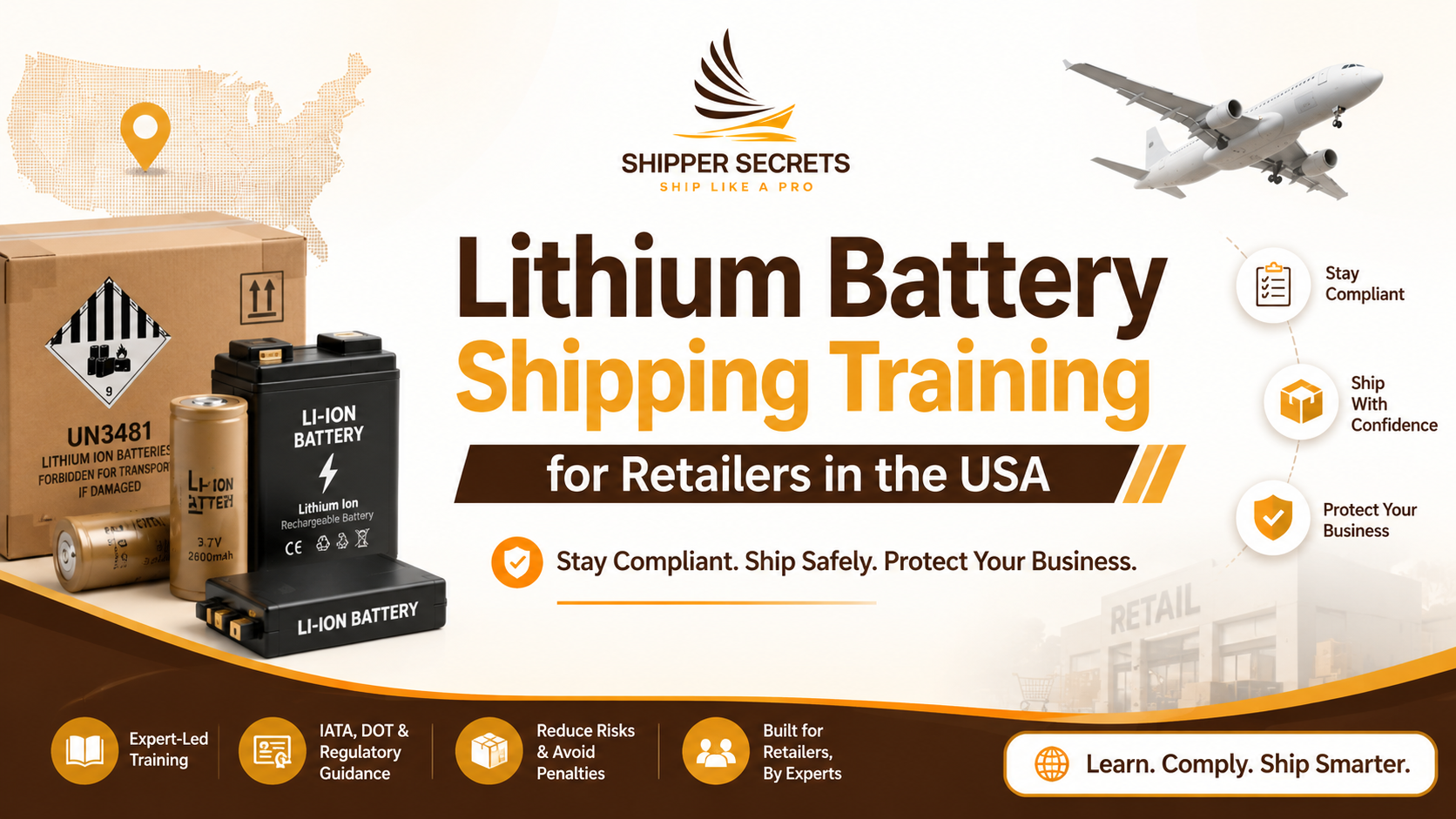
The demand for lithium-powered products continues to grow across the retail industry. From smartphones and laptops to power tools, electric mobility devices, cameras, toys, and portable electronics, retailers are increasingly involved in the sale and shipment of products containing lithium batteries.
However, shipping lithium batteries is not the same as shipping ordinary consumer products. Lithium-ion and lithium-metal batteries are regulated as dangerous goods because they can present fire and safety risks when improperly packaged, handled, labeled, documented, or transported.
For retailers in the United States, Lithium Battery Shipping Training is an important part of building a safe and compliant shipping process. Proper training helps employees understand applicable transportation requirements and reduces the risk of shipping errors, rejected packages, regulatory violations, and transportation incidents.
Why Do Retailers Need Lithium Battery Shipping Training?
Retailers may encounter lithium batteries throughout their supply chain. A business may receive products from manufacturers, ship products directly to customers, return damaged products, manage warranty replacements, or distribute batteries separately.
Employees involved in these activities need to understand how lithium batteries are regulated and how shipping requirements can vary depending on the battery type, configuration, packaging, quantity, and transportation method. According to the U.S. Department of Transportation’s Pipeline and Hazardous Materials Safety Administration (PHMSA), lithium cells and batteries must be classified, packaged, marked, labeled, and documented in accordance with 49 CFR §173.185, and the specific requirements differ depending on whether the battery is shipped alone, packed with equipment, or contained in equipment.phmsa.dot+2
Training helps retail employees understand:
-
How lithium batteries are classified – Under 49 CFR, lithium-ion and lithium-metal cells and batteries are assigned distinct UN numbers (e.g., UN 3480, 3481, 3090, 3091) and are subject to different packing instructions and exceptions.
-
The difference between lithium-ion and lithium-metal batteries – PHMSA and FAA guidance emphasize that lithium-ion (rechargeable) and lithium-metal (primary) batteries have different hazard profiles and regulatory limits, including watt-hour or lithium content thresholds that determine whether a shipment qualifies for “excepted” or “fully regulated” status.
-
How batteries shipped alone differ from batteries packed with or contained in equipment – The PHMSA Lithium Battery Guide for Shippers provides scenario-based rules showing that packaging strength, quantity limits per package, and marking requirements change based on whether batteries are standalone, packed with equipment, or installed in devices.
-
Packaging requirements – According to PHMSA’s “How to Safely Send Batteries and Battery Powered Devices by Mail” guidance, consumer lithium batteries must be protected against short circuits, movement, and accidental activation, and must be placed in strong, rigid outer packaging; loose batteries or batteries packed with metal objects are not permitted.
-
Marking and labeling requirements – For air transport, the FAA’s Interactive Guide to Shipping Lithium Batteries (aligned with ICAO Technical Instructions) specifies when lithium battery handling labels, proper shipping names, and UN markings are required, and notes that carriers may impose additional restrictions beyond the regulations.
-
Documentation requirements – PHMSA and the Code of Federal Regulations require that fully regulated lithium battery shipments include a shipper’s declaration, proper shipping name, hazard class, UN number, packing group (where applicable), and emergency response information; excepted shipments may have reduced documentation but still require specific markings.
-
Carrier-specific restrictions – The FAA explicitly states that shippers must “always check the full regulations and carrier requirements before shipping,” because passenger and cargo airlines, as well as integrators, often prohibit or restrict certain lithium battery configurations that are otherwise legal under the baseline regulations.
-
Ground and air transportation considerations – PHMSA regulates ground shipments under 49 CFR, while the FAA enforces hazardous materials rules for air transport and references ICAO standards; requirements for quantities, packaging, and approvals can differ significantly between modes.phmsa.
-
How to recognize damaged, defective, or recalled batteries – PHMSA guidance highlights that damaged or defective lithium batteries (those that could rapidly disassemble, violently react, or produce a dangerous evolution of heat) are generally forbidden for transport unless specifically authorized, making it critical for retail staff to identify and quarantine such units.phmsa.
-
Emergency response and incident reporting responsibilities – Under federal hazmat regulations, retailers that offer lithium batteries for transport must ensure employees know how to respond to leaks, fires, or incidents and understand when and how to notify carriers and authorities, as required by 49 CFR and reinforced in PHMSA safety communications.phmsa.
Without adequate knowledge, even a routine shipment can create compliance challenges. As PHMSA and FAA materials make clear, misclassified, improperly packaged, or incorrectly documented lithium battery shipments can be rejected, delayed, fined, or, in worst cases, contribute to in-transit fires and safety incidents
What Is Lithium Battery Shipping Training?
Lithium battery shipping training is a mandatory U.S. Department of Transportation (DOT) requirement under 49 CFR that ensures anyone who classifies, packages, marks, labels, documents, or offers lithium cells and batteries for transport understands how to comply with federal hazardous materials (hazmat) regulations. According to PHMSA and FAA guidance, employers must provide initial and recurrent training (at least every 3 years domestically, or every 2 years under ICAO for air) covering general awareness, function-specific duties, safety, and security, and must maintain training records for at least 3 years. The training is based on official resources such as PHMSA’s “Lithium Battery Guide for Shippers” (updated October 2024) and the FAA’s “Interactive Guide to Shipping Lithium Batteries,” which align with the latest HM‑215Q rule and ICAO Technical Instructions.
Retail businesses should ensure that training is appropriate for the duties employees actually perform. Someone who only handles packaged consumer products may have different responsibilities from an employee who prepares lithium batteries for shipment by air.
1. Understand Lithium Battery Regulations
One of the biggest benefits of lithium battery shipping training is helping employees understand that different shipments may have different regulatory requirements.
Lithium batteries can be transported in several configurations, including:
-
Batteries shipped by themselves
-
Batteries packed with equipment
-
Batteries contained in equipment
-
Lithium-ion batteries
-
Lithium-metal batteries
Each shipment must be evaluated based on its specific characteristics and applicable transportation regulations.
Training gives employees a structured approach to identifying the requirements that apply to a shipment instead of relying on assumptions.
2. Learn Proper Packaging Procedures
Packaging plays an important role in lithium battery transportation safety.
Retail employees must understand how batteries and battery-powered products should be protected against damage, short circuits, movement, and other potential hazards during transportation.
Proper training can help employees recognize the importance of:
-
Using appropriate packaging
-
Preventing battery movement
-
Protecting terminals from short circuits
-
Using suitable inner packaging when required
-
Inspecting packages before shipment
-
Following applicable carrier and regulatory requirements
A package that appears secure on the outside may still create a safety issue if the battery is not properly protected inside.
3. Identify Marking and Labeling Requirements
One of the most common areas of shipping confusion involves package markings and labels.
Depending on the shipment, lithium battery packages may require specific marks, labels, or other information. The requirements can depend on factors such as battery type, quantity, configuration, and mode of transportation.
Training helps employees understand when markings or labels may be required and how to apply them correctly.
This can reduce the possibility of:
-
Incorrect markings
-
Missing labels
-
Improper package preparation
-
Carrier rejection
-
Shipment delays
Employees should also understand that marking and labeling requirements can change when shipping conditions or transportation modes change.
4. Improve Air Shipping Compliance
Air transportation can involve additional requirements for lithium battery shipments.
Retailers that ship products internationally or use air transportation should make sure employees understand the applicable requirements for their responsibilities.
Air shipments may require careful attention to:
-
Battery classification
-
State of charge requirements where applicable
-
Packaging
-
Marks and labels
-
Documentation
-
Carrier acceptance requirements
-
Restrictions involving damaged or defective batteries
Training helps employees recognize that a shipment acceptable for one transportation method may not automatically be acceptable for another.
5. Reduce Shipping Delays and Rejected Packages
Incorrectly prepared lithium battery shipments can be delayed or rejected by carriers.
For retailers, shipping delays can affect:
-
Customer satisfaction
-
Product delivery times
-
Returns
-
Warranty replacements
-
Inventory movement
-
International orders
Employee training can help identify potential problems before a package enters the transportation network.
A well-trained team is better positioned to check shipments for common errors and follow established procedures consistently.
6. Handle Returns and Damaged Products Correctly
Retailers frequently manage product returns. Some returned products may contain lithium batteries that are damaged, swollen, leaking, overheating, or otherwise defective.
These situations require special attention.
Employees should be trained to recognize potentially dangerous battery conditions and understand that damaged, defective, or recalled batteries may be subject to different transportation requirements.
Retailers should establish clear procedures for:
-
Identifying potentially damaged batteries
-
Separating unsafe products when necessary
-
Notifying the appropriate personnel
-
Following applicable regulatory requirements
-
Using qualified shipping processes for permitted transportation
Employees should never assume that a damaged lithium battery can be shipped using the same process as a normal consumer product.
7. Support Employee Safety
Lithium battery training is not only about regulatory compliance. It also supports workplace safety.
Retail and warehouse employees may interact with lithium batteries during:
-
Receiving
-
Inventory management
-
Order fulfillment
-
Packaging
-
Shipping
-
Returns
-
Product disposal
Understanding potential hazards helps employees recognize situations that require additional caution.
Training can also help employees understand the importance of reporting unusual battery conditions instead of ignoring them.
8. Build a Consistent Shipping Process
Retailers may have multiple employees preparing shipments across different locations.
Without standardized training, employees may interpret shipping requirements differently. This can lead to inconsistent practices and increased compliance risk.
A structured training program can help retailers establish consistent procedures for:
-
Shipment evaluation
-
Packaging
-
Marking
-
Labeling
-
Documentation
-
Carrier selection
-
Recordkeeping
-
Incident response
Consistency is especially important for retailers operating warehouses, fulfillment centers, stores, or distribution facilities across multiple locations.
9. Train Employees Based on Their Job Responsibilities
Not every employee needs the same level of lithium battery training.
Retailers should identify which employees perform regulated functions and provide training appropriate to their responsibilities.
Potentially relevant employees may include:
-
Shipping department staff
-
Warehouse employees
-
Fulfillment teams
-
Logistics coordinators
-
Distribution center employees
-
E-commerce shipping teams
-
Returns personnel
-
Dangerous goods specialists
-
Supervisors and managers responsible for shipping operations
The right training approach depends on what each employee does and which transportation modes the company uses.
10. Keep Training Current
Lithium battery transportation requirements can change as regulations, industry standards, and carrier policies evolve.
Retailers should maintain a process for keeping employees informed about relevant changes.
Companies should consider:
-
Reviewing training requirements regularly
-
Updating internal shipping procedures
-
Monitoring regulatory changes
-
Reviewing carrier requirements
-
Refreshing employee knowledge when necessary
-
Maintaining appropriate training records
Regular review can help businesses avoid relying on outdated shipping procedures.
What Should Lithium Battery Shipping Training Cover?
A comprehensive training program for retailers may address several important areas.
General Awareness Training
Employees learn why lithium batteries are regulated and how improper transportation can create safety risks.
Function-Specific Training
Employees receive training related to the specific tasks they perform, such as packaging, marking, labeling, or preparing shipments.
Safety and Security Awareness
Employees learn how to recognize potential hazards and understand basic security responsibilities associated with dangerous goods transportation.
Emergency Response Information
Employees should know what to do if an incident occurs and understand the appropriate procedures for reporting or escalating a problem.
Transportation-Specific Requirements
Employees involved in air, ground, or other transportation methods should understand the requirements relevant to their assigned responsibilities.
Who Should Take Lithium Battery Shipping Training?
Lithium battery shipping training may be relevant to retailers that sell or distribute products such as:
-
Consumer electronics
-
Smartphones and tablets
-
Laptops
-
Cameras
-
Wireless devices
-
Power tools
-
Drones
-
Portable chargers
-
E-bikes and mobility products
-
Toys with rechargeable batteries
-
Electronic accessories
-
Replacement batteries
Any retailer involved in shipping products containing lithium batteries should evaluate its employee training needs.
How Can Retailers Choose the Right Training Program?
When selecting a lithium battery shipping training program, retailers should consider whether the course:
-
Covers the regulations relevant to their operations
-
Addresses the transportation modes they use
-
Includes job-specific responsibilities
-
Explains packaging and documentation requirements
-
Covers damaged and defective batteries
-
Provides practical examples
-
Helps employees understand common shipping errors
-
Supports required training documentation
The objective should be more than simply completing a course. Employees should finish training with a clear understanding of how to perform their assigned shipping responsibilities safely and correctly.
Final Thoughts
Lithium batteries are an essential part of modern retail, but shipping them requires careful attention to safety and regulatory requirements. Retailers that sell, distribute, or return lithium battery-powered products should make employee education an important part of their logistics strategy.
Lithium Battery Shipping Training for Retailers in the USA can help employees better understand applicable requirements, improve shipping processes, reduce avoidable mistakes, and support safer transportation practices.
As lithium-powered products continue to expand across the retail market, investing in proper employee training can help retailers build a more reliable and compliant shipping operation.
Frequently Asked Questions
1. Why is lithium battery shipping training important for retailers?
Lithium battery shipping training helps employees understand the requirements that may apply when preparing, packaging, marking, labeling, and offering lithium battery shipments for transportation.
2. Do retailers need training for shipping products containing lithium batteries?
Retailers should evaluate their training obligations based on the functions employees perform and the applicable transportation regulations. Employees who perform regulated hazardous materials functions may require appropriate training.
3. Is shipping lithium batteries by air different from ground shipping?
Yes. Air transportation can involve additional requirements and restrictions. Retailers should ensure employees understand the rules applicable to their specific shipments and transportation methods.
4. Can damaged lithium batteries be shipped normally?
Not necessarily. Damaged, defective, or recalled batteries may be subject to additional requirements or restrictions. Retailers should have procedures for identifying and handling such batteries safely.
5. How often should lithium battery shipping training be updated?
Training should be maintained according to applicable regulatory requirements and updated when regulations, employee responsibilities, or company shipping procedures change.
Start Building a Safer Lithium Battery Shipping Process
Retailers that ship lithium battery-powered products need knowledgeable employees and reliable procedures. Proper training can help your team understand shipping responsibilities and reduce the risks associated with improper battery transportation.
Explore professional Lithium Battery Shipping Training options to help your retail, warehouse, and logistics teams prepare lithium battery shipments with greater confidence.
📞 Contact Us
📍 868 Cardiff Road, Naperville, IL 60565
📞 708.275.8418
🌐 Get in touch with our logistics experts for reliable shipping and freight solutions. 🚚✈️📦

 English
 Arabic
 French
 Spanish
 Portuguese
 Deutsch
 Turkish
 Dutch
Dutch
 Italiano
 Russian
 Romaian
 Greek
Greek