


Snow Day Calculator UK 2026: Will School Close Tomorrow?
Introduction
Woken up to snow on the ground and wondering if today's the day school gets cancelled? You're not alone. Every winter, millions of parents, teachers, and students across the UK refresh their phones at 6am hoping for that golden text: "school closed today."
Here's the problem: most snow day calculators you'll find online are built for the US. They talk about "superintendents," "inches of snow," and school districts that don't exist here. None of that maps cleanly onto how UK schools actually decide to close.
This guide fixes that. Below, you'll find a UK-specific breakdown of how snow day calculators work, what actually drives closure decisions in England, Scotland, Wales, and Northern Ireland, and a step-by-step way to predict your own odds, plus insights competitor sites simply don't cover.
What Is a Snow Day Calculator (And How Is the UK Different)?
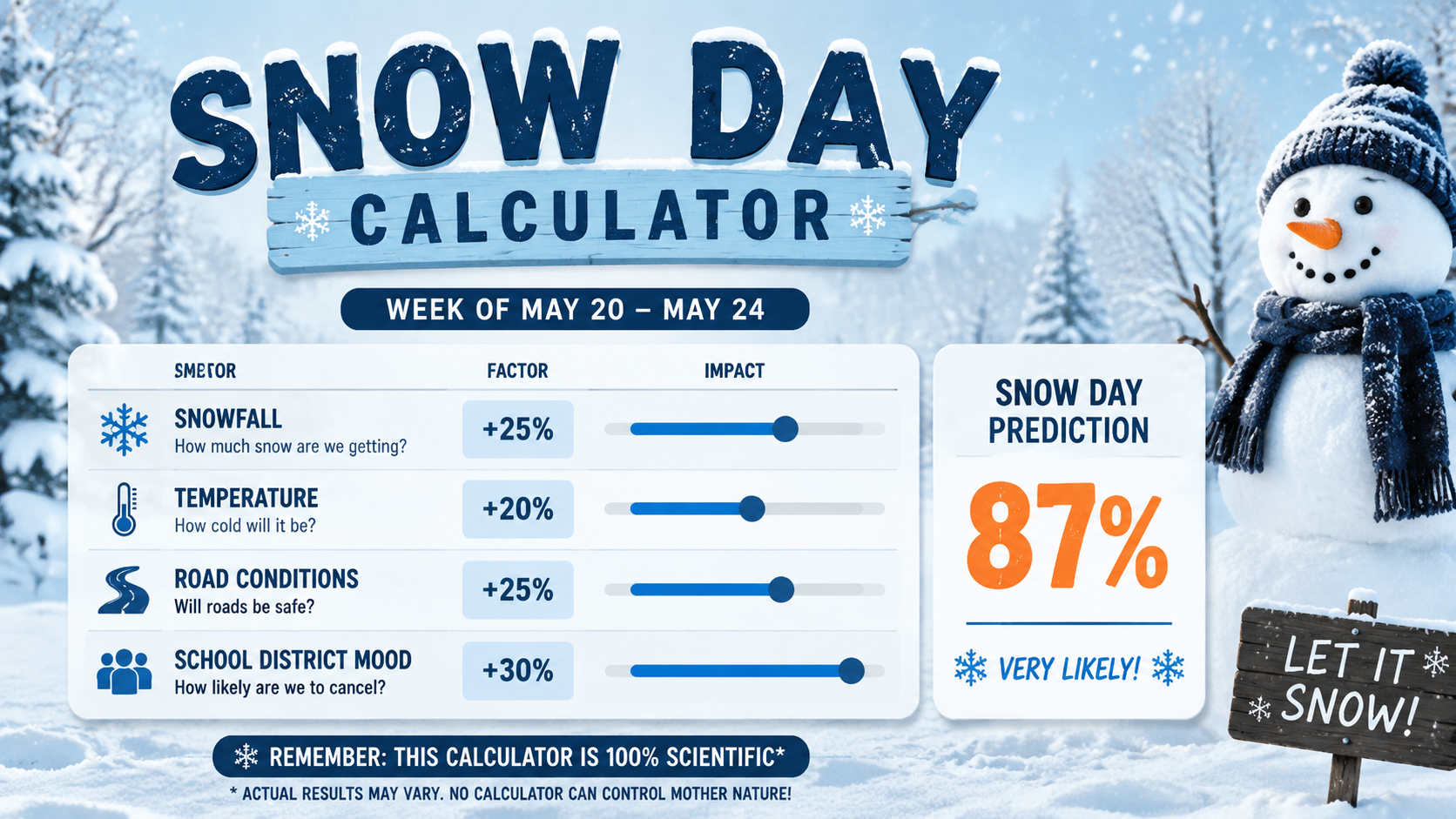
A snow day calculator is a tool that estimates the probability your school will close due to bad weather, using inputs like:
- Forecasted snowfall and ice
- Overnight temperature and wind chill
- Local road and pavement conditions
- Historical closure patterns for your area
The key difference in the UK: there's no single "snow day calculator" governing body. Unlike the US, where school districts often follow near-identical closure playbooks, UK school closures are decided school-by-school, or by the local authority (LA) for maintained schools and by the headteacher or academy trust for academies. That means two schools half a mile apart can make completely different calls on the same snowy morning.
Quotable insight: "In the UK, a snow day isn't a weather event, it's a governance event. The snow triggers the question; the headteacher or LA answers it."
How UK School Snow Closures Actually Work
1. Who Makes the Decision?
- Maintained/community schools: Usually the local authority, in consultation with the headteacher, decides based on gritting priorities, bus routes, and staff travel.
- Academies and free schools: The headteacher or trust makes the final call independently, which is why academies sometimes stay open when nearby council schools close.
- Private/independent schools: Decided entirely in-house, often with more flexibility for remote learning days.
2. The Factors That Actually Move the Needle
Ask yourself these before checking any calculator:
- Can staff physically get in? Many UK closures happen not because kids can't reach school, but because teachers commuting from surrounding villages can't get through untreated roads.
- Is the school on a gritting route? Council gritting priorities (usually A-roads and bus routes first) matter more in the UK than raw snowfall totals.
- Is there a Met Office Amber or Red warning? Schools are far more likely to close under an Amber/Red snow or ice warning than a Yellow one, regardless of how much snow has actually fallen.
- Heating and building safety: Burst pipes, power cuts, and boiler failures close nearly as many UK schools each winter as the snow itself, a factor almost no calculator accounts for.
3. Regional Reality Check
- Scotland and the North: Higher snow tolerance; schools often stay open through conditions that would shut schools in the South within hours.
- Southern England: Lower snow tolerance and less gritting infrastructure means even 2 to 3cm can trigger closures.
- Rural vs urban: Rural schools close more often due to single-track roads and bus route risk, even with light snowfall.
Step-by-Step: How to Predict Your Own Snow Day Chances
- Check the Met Office warning level for your postcode (Yellow, Amber, or Red) the evening before.
- Look at overnight low temperature. Below -2°C with any precipitation sharply raises ice risk on untreated roads.
- Check your council's gritting map (most UK councils publish these online) to see if your school's road is a priority route.
- Review your school's history. Search "[school name] snow closure" or check their Twitter/X and Facebook page; most UK schools now post closure decisions there by 6:30 to 7am.
- Factor in staff commute distance. If your school draws teachers from rural areas, factor in an extra closure risk.
- Combine, don't rely on one source. Cross-check Met Office data with your council gritting schedule and the school's own communication channel for the most realistic picture.
Pro Tips Competitor Sites Miss
- Check the night before, not the morning of. Most UK closure decisions are actually made between 5:30am and 6:45am, but the underlying call is usually set the evening before based on the overnight forecast.
- Academies move faster than council schools. If your child attends an academy, don't assume the LA's general closure guidance applies.
- Snow days rarely mean a genuine "day off" anymore. Since 2020, many UK schools now default to remote learning on snow days rather than a full closure, so check your school's specific snow policy, not just its historic closure rate.
- Watch black ice, not snow depth. UK closures are driven more by ice risk on the school run than by snow accumulation, a nuance most global calculators ignore entirely.
Key Takeaways
- UK snow closures are decided locally (by LA, academy trust, or headteacher), not by a national system.
- Met Office Amber/Red warnings are a stronger predictor than raw snowfall.
- Staff commute and gritting routes often matter more than how much snow falls at the school itself.
- Remote learning has changed what a "snow day" even means in the UK since 2020.
Conclusion
There's no single, perfectly accurate snow day calculator for the UK, because the decision itself isn't standardised. But by combining Met Office warning levels, your council's gritting priorities, your school's own closure history, and an understanding of who actually makes the call at your school, you can build a genuinely reliable prediction of your own.
So next time the forecast shows snow, don't just check a generic calculator built for American school districts. Check your council's gritting map, your school's communication channel, and the warning level for your postcode. That combination will beat any single-number percentage every time.

 English
 Arabic
 French
 Portuguese
 Deutsch
 Turkish
 Dutch
Dutch
 Italiano
 Russian
 Romaian
 Portuguese (Brazil)
 Greek
Greek