


Why High-Quality Audio Datasets Are Essential for AI?
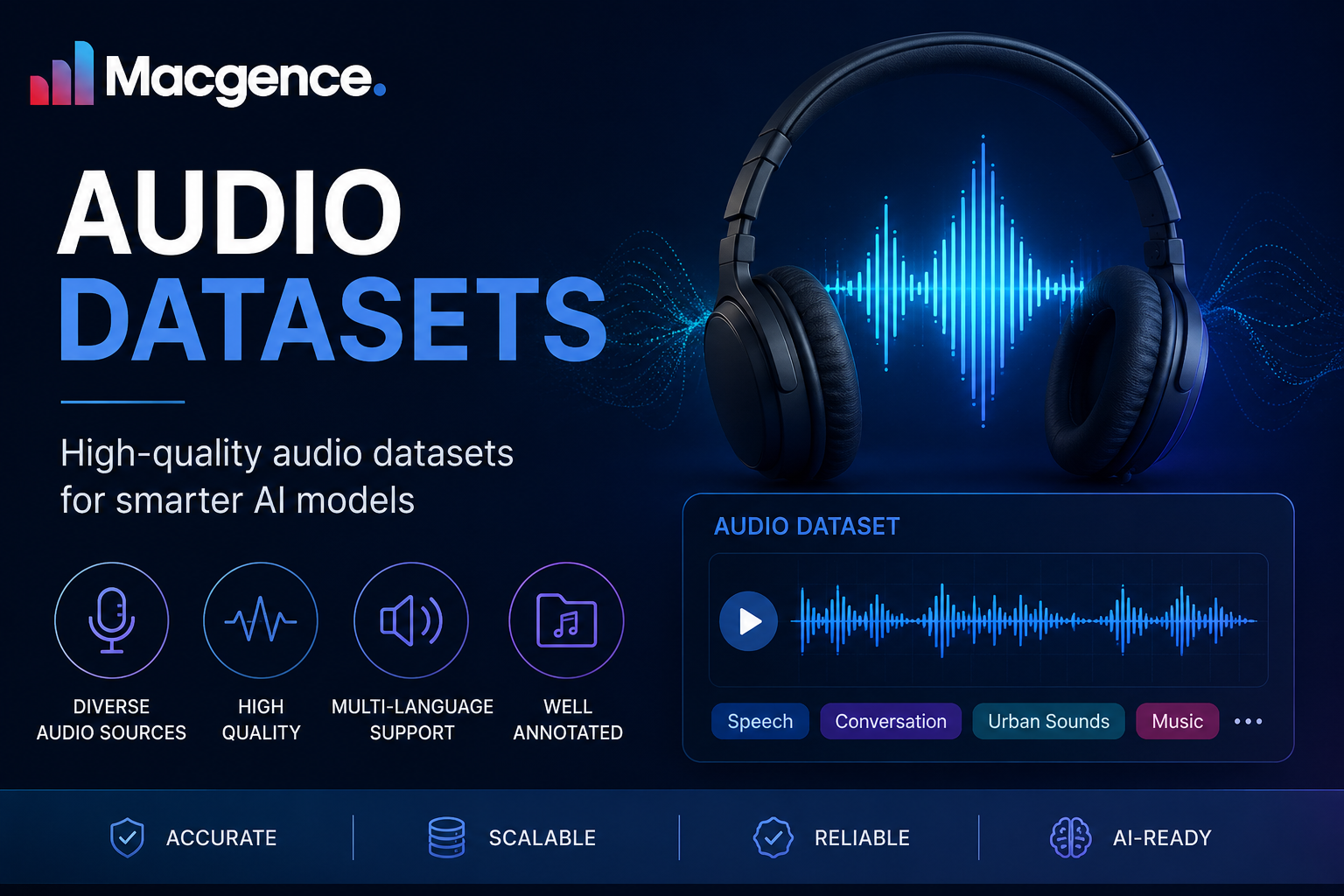
Artificial intelligence is transforming the way people interact with technology. From voice assistants and speech recognition systems to customer support bots and healthcare applications, AI is becoming smarter every day. However, behind every successful AI model lies one important element audio datasets.
What Are Audio Datasets?
Audio datasets are collections of recorded sounds or speech used to train, test, and improve AI models. These recordings may include conversations, voice commands, environmental sounds, music, or industry-specific audio.
The purpose of these datasets is to help AI understand and process different types of sounds accurately. A well-prepared dataset includes recordings from people of different ages, genders, languages, accents, and environments, making AI systems more adaptable and reliable.
Why Data Quality Matters in AI?
Artificial intelligence learns from the data it receives. If the training data contains errors, background noise, incorrect labels, or limited diversity, the AI model may produce inaccurate results.
High-quality data helps AI:
- Recognize speech with greater accuracy
- Understand different accents and dialects
- Reduce recognition errors
- Perform consistently in real-world environments
- Improve user experience
Key Benefits of High-Quality Audio Datasets
1. Better Speech Recognition
Speech recognition technology has become a part of everyday life. Whether people use smartphones, smart speakers, or virtual assistants, they expect fast and accurate responses.
2. Improved Voice Assistants
Voice assistants need to understand natural conversations rather than just individual words. They must recognize different pronunciations, speaking speeds, and tones.
3. Supports Multiple Languages
Many businesses serve customers across different countries. AI models trained on multilingual recordings can understand several languages and regional accents.
4. Reduces AI Bias
If an AI model is trained using recordings from only one group of speakers, it may struggle to understand others.
5. Better Performance in Noisy Environments
Real-world conversations rarely happen in silent rooms. People speak in offices, markets, airports, cars, and public spaces.
Training AI with recordings collected from different environments enables it to separate speech from background noise and maintain strong performance.
Industries That Benefit from Audio Datasets
Many industries depend on speech technology and sound recognition.
Healthcare
Healthcare organizations use AI to assist with medical transcription, patient documentation, and voice enabled healthcare solutions. Accurate datasets improve recognition accuracy and reduce documentation errors.
Customer Service
AI-powered call centers use speech recognition to automate customer interactions, analyze conversations, and improve support quality.
Automotive
Modern vehicles include voice-controlled navigation, entertainment systems, and hands free communication. High-quality datasets improve these features and create safer driving experiences.
Education
Online learning platforms use voice recognition for language learning, pronunciation evaluation, and accessibility tools.
Banking
Banks use voice authentication to improve account security and customer verification while delivering faster services.
Characteristics of High-Quality Audio Datasets
Not every dataset delivers the same results. High quality datasets usually have several important characteristics.
Diverse Speakers
A reliable dataset includes voices from different:
- Age groups
- Genders
- Regions
- Languages
- Accents
This diversity improves AI performance across broader user groups.
Clear Recordings
Audio should be recorded with minimal distortion while also including realistic environmental conditions where needed.
Accurate Annotation
Each recording must be labeled correctly. Proper transcription and metadata ensure AI learns the right patterns during training.
Ethical Data Collection
Responsible data collection includes participant consent, privacy protection, and compliance with applicable regulations.
Balanced Data Distribution
A balanced dataset prevents AI from becoming biased toward one language, accent, or speaking style.
How Professional Data Collection Improves AI?
Building datasets internally can be time-consuming and expensive. Professional data collection providers simplify the process by offering structured workflows, quality assurance, and experienced annotation teams.
Macgence helps businesses collect, validate, and annotate speech data tailored to AI training requirements. Their focus on accuracy and quality enables organizations to develop reliable speech recognition and voice AI solutions.
Best Practices for Creating Effective Audio Data
Organizations can improve AI training results by following a few essential practices:
- Collect recordings from diverse demographics.
- Include multiple languages and regional accents.
- Record audio in different real-world environments.
- Apply strict quality checks during annotation.
- Continuously update datasets with fresh recordings.
- Remove duplicate or low-quality files.
- Maintain ethical standards throughout data collection.
Following these practices helps AI adapt to changing user behavior and real-world situations.
The Future of Audio AI
Voice technology continues to expand across industries. Smart homes, healthcare systems, customer support platforms, autonomous vehicles, and wearable devices increasingly rely on speech recognition.
As AI applications become more advanced, the demand for accurate training data will continue to grow. Organizations investing in high-quality audio datasets today will be better positioned to build intelligent systems that understand users naturally, respond quickly, and deliver consistent performance.
Companies that prioritize data quality also reduce long-term development costs because their AI models require fewer corrections after deployment.
Why Choosing the Right Data Partner Matters?
Selecting an experienced data collection partner can significantly improve AI development outcomes. A trusted provider understands the importance of quality control, data diversity, accurate annotation, and ethical collection practices.
As AI adoption continues to grow, dependable training data remains one of the strongest foundations for successful machine learning projects.
Frequently Asked Questions (FAQs)
1. What are audio datasets used for?
Datasets are used to train AI models for speech recognition, voice assistants, speaker identification, sound classification, and many other voice-enabled applications.
2. Why are high-quality datasets important for AI?
High-quality datasets improve model accuracy, reduce errors, minimize bias, and help AI perform effectively in real-world situations.
3. Which industries use audio datasets?
Healthcare, automotive, banking, education, telecommunications, customer service, and smart device manufacturers all use audio to train AI systems.
4. How does Macgence support AI development?
Macgence provides professional audio data collection and annotation services that help organizations build accurate, scalable, and reliable AI models through high-quality training data.
Conclusion
Artificial intelligence is only as effective as the data used to train it. High-quality audio help AI understand speech accurately, recognize diverse voices, reduce bias, and perform reliably in real-world environments. Whether developing voice assistants, healthcare applications, automotive systems, or customer service solutions, investing in quality data leads to better AI performance and improved user experiences.
Partnering with experienced providers like Macgence ensures organizations have access to reliable data collection and annotation processes that support long-term AI success. As voice technology continues to evolve, high-quality datasets will remain one of the most valuable assets in building smarter and more dependable AI systems.
contact now!!!
For more information visit here — https://macgence.com/blog/multilingual-audio-datasets-for-tts-and-ai-voice-models/

 English
 Arabic
 French
 Spanish
 Portuguese
 Deutsch
 Turkish
 Dutch
Dutch
 Italiano
 Russian
 Portuguese (Brazil)
 Greek
Greek