


The Dawn of a New Internet: An Introduction to Web 3.0 Blockchain
The Next Evolution of the World Wide Web
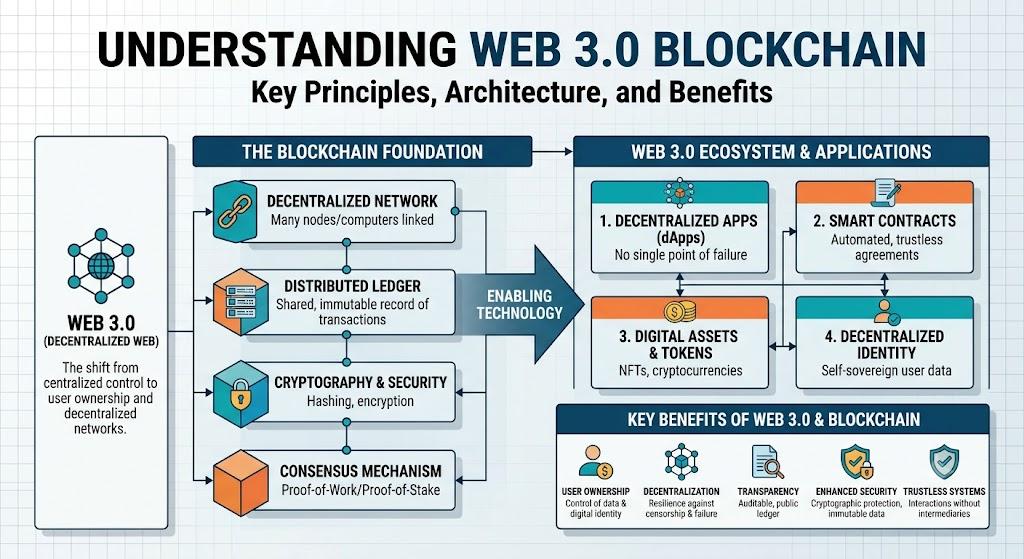
Web 3.0 represents the next evolutionary phase of the internet, a paradigm shift from the current corporate-dominated Web 2.0 to a decentralized, user-owned digital landscape. At its core, this new iteration is built upon the foundational principles of decentralization, transparency, and user empowerment, facilitated primarily by blockchain technology. Unlike today's internet, where a few large corporations act as gatekeepers of data and platforms, Web 3.0 envisions a world where users control their own digital identity, data, and assets. The comprehensive Web 3.0 Blockchain industry is pioneering this transformation, creating an ecosystem of applications and services that are not owned by any single entity but are collectively operated by their users. This fundamental restructuring aims to create a more equitable, open, and permissionless internet, where value flows back to the creators and participants rather than being concentrated in the hands of intermediaries. This transition is not merely a technological upgrade; it is a philosophical movement aimed at rewriting the rules of digital interaction, ownership, and governance for a more democratic and user-centric future.
The Foundational Technology Stack
The architecture of Web 3.0 is a complex and evolving stack of technologies designed to enable decentralization at every level. The bedrock of this stack is the Layer-1 blockchain, such as Ethereum, Solana, or Avalanche. These blockchains provide the secure, decentralized ledger and smart contract functionality necessary to build trustless applications. However, as these Layer-1s face challenges with scalability and transaction costs, a crucial second layer has emerged: Layer-2 scaling solutions. Technologies like Optimistic Rollups and Zero-Knowledge (ZK) Rollups process transactions off the main chain, inheriting its security while dramatically increasing speed and reducing fees, making applications viable for mass adoption. For data storage, Web 3.0 moves away from centralized servers like Amazon Web Services (AWS) towards decentralized storage networks like IPFS (InterPlanetary File System) and Arweave, ensuring that data is resilient, censorship-resistant, and not controlled by a single company. Finally, decentralized identity (DID) solutions are being developed to give users a single, self-sovereign identity that they can use across the entire Web 3.0 ecosystem, eliminating the need for multiple passwords and giving them ultimate control over their personal information.
Core Applications and Use Cases
The theoretical principles of Web 3.0 are already manifesting in a variety of powerful and innovative use cases that are disrupting traditional industries. Decentralized Finance (DeFi) is arguably the most developed sector, creating a parallel financial system that offers services like lending, borrowing, and trading without relying on traditional banks or intermediaries. Platforms like Uniswap and Aave allow anyone with an internet connection to access financial services in a permissionless and transparent manner. Non-Fungible Tokens (NFTs) have revolutionized the concept of digital ownership, providing a verifiable way for artists, musicians, and creators to monetize their work directly and for collectors to prove ownership of unique digital assets. This has given rise to a vibrant creator economy. Beyond finance and art, Decentralized Autonomous Organizations (DAOs) are pioneering new models of digital governance. These are internet-native organizations where rules are encoded in smart contracts and decisions are made collectively by members who hold governance tokens, offering a transparent and democratic alternative to traditional corporate structures for everything from managing protocols to funding social causes.
The Vision and Its Inherent Challenges
The ultimate vision of Web 3.0 is a compelling one: a truly open, fair, and user-owned internet where power is distributed, and innovation can flourish without permission from central gatekeepers. It promises a world where creators are fairly compensated, users own their data, and communities can self-organize and govern themselves effectively. However, the path to achieving this vision is fraught with significant challenges. The user experience (UX) of many Web 3.0 applications is still complex and intimidating for non-technical users, involving difficult concepts like managing crypto wallets and gas fees. Scalability, while being addressed by Layer-2 solutions, remains a major hurdle to supporting a global user base with the same speed and low cost as Web 2.0 applications. The regulatory landscape is another major uncertainty, with governments around the world grappling with how to approach this new paradigm, creating a precarious environment for builders and investors. Finally, the security of this new frontier is a constant battle, with smart contract exploits and hacks posing a significant risk to user funds and trust in the ecosystem. Overcoming these obstacles will be the primary focus for the industry as it strives to build the internet of tomorrow.
Explore More Like This in Our Regional Reports:
France 5G Mm Wave Technology Market

 English
 Arabic
 French
 Spanish
 Portuguese
 Deutsch
 Turkish
 Italiano
 Russian
 Romaian
 Portuguese (Brazil)
 Greek
Greek