


How Singapore Students Can Improve US University Admission Chances with the ACT Test
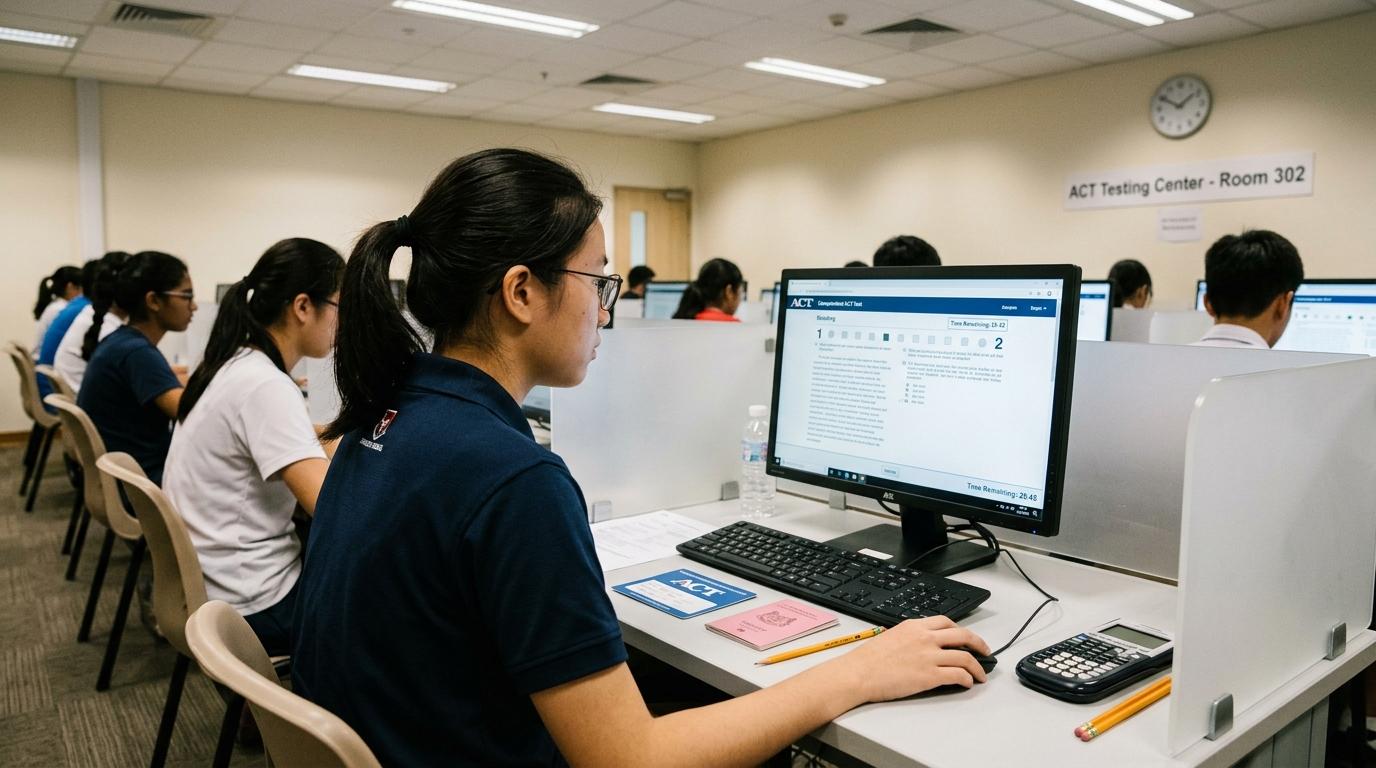
Getting into a top US university is one of the most competitive processes a Singapore student will face. Strong grades alone rarely tell the full story — American universities want a complete picture of who you are academically.
That's where the ACT test preparation for Singapore students becomes genuinely valuable. A strong score gives admissions officers a standardised, internationally recognised benchmark — one that can work strongly in your favour when your application is reviewed alongside thousands of others.
This guide breaks down exactly how Singapore students can use the ACT strategically to strengthen their US university applications.
Why US Universities Value Standardised Test Scores
Many top US universities — including those in the Ivy League and other highly selective institutions — have returned to requiring standardised test scores after the COVID-era test-optional period.
Here's why these scores still matter:
-
They provide a common academic benchmark across different school systems worldwide
-
They help admissions officers compare applicants fairly from Singapore, India, the UK, and the US
-
A strong score can offset a slightly lower GPA or compensate for a less-recognised curriculum
-
For merit scholarships, test scores often remain a key eligibility criterion
For Singapore students whose A-Level or IB results may not translate obviously into the US system, a high ACT score communicates academic strength in a language every US admissions officer understands immediately.
ACT vs SAT — Which Should Singapore Students Choose?
This is the first question most students ask. Here's a straightforward comparison:
|
Feature |
ACT |
SAT |
|
Sections |
English, Math, Reading, Science, Writing (optional) |
Reading & Writing, Math |
|
Science Section |
Yes — tests data interpretation |
No |
|
Math Level |
Up to trigonometry |
Up to pre-calculus |
|
Timing |
More time-pressured |
Slightly more time per question |
|
Best For |
Students strong in science and data reasoning |
Students stronger in verbal reasoning |
For Singapore students specifically:
-
Strong in Additional Mathematics or Physics? The ACT's Science section often suits you well
-
Comfortable with fast-paced reading and data interpretation? ACT is worth prioritising
-
Neither is inherently harder — it depends entirely on your strengths
The smartest move is to take a full practice test for both and let your diagnostic scores guide the decision.
What Does a Competitive ACT Score Look Like?
Scores range from 1 to 36, with 36 being a perfect score.
|
University Tier |
Typical ACT Middle 50% Range |
|
Ivy League / Top 10 |
34 – 36 |
|
Top 25 Universities |
32 – 35 |
|
Strong Target Schools |
28 – 32 |
|
Good Safety Schools |
24 – 28 |
For Singapore students targeting universities like MIT, Harvard, Princeton, or Stanford, a score of 34 or above puts you in a genuinely competitive range.
For strong target universities like UCLA, University of Michigan, or NYU, a 30 to 33 is a realistic and competitive goal with proper preparation.
How Singapore's Curriculum Aligns With the ACT
Here's something most students don't realise: Singapore's education system actually prepares you well for the ACT — if you know where the overlaps are.
A-Level and IP students:
-
H2 Mathematics covers most of the ACT Math content
-
General Paper and Literature build reading comprehension skills
-
Science subjects directly support the ACT Science section's data interpretation questions
IB students:
-
HL Mathematics and Sciences align closely with ACT Math and Science
-
Extended Essay and Theory of Knowledge build analytical writing skills
Polytechnic students:
-
Applied coursework builds the practical reasoning skills the ACT Science section rewards
-
Engineering and Business students often perform strongly on ACT Math
The gap between what you already know and what the ACT tests is smaller than you think. The key is learning how the ACT asks questions — which is different from how Singapore exams test the same content.
Mini Student Case Study
Student Profile: Ryan, 17, Singapore IP student, targeting Business programmes at US universities
Ryan's school grades were strong — but he was applying to universities like UMich Ross and NYU Stern, where the applicant pool is highly international and competitive.
His first ACT practice test came back at 27. Not bad, but not where he needed to be for his target schools.
Over 14 weeks, Ryan focused specifically on:
-
ACT English grammar rules — a weak area for many Singapore students
-
Timed Reading passage strategies
-
ACT Science — interpreting conflicting viewpoints passages
His official score: 32. That score, combined with his academic record and extracurriculars, earned him offers from both UMich Ross and NYU Stern.
The improvement didn't happen by studying harder. It happened by studying smarter — understanding the ACT's specific question patterns and testing logic.
Common Mistakes Singapore Students Make
These are the errors that consistently cost students points:
1. Starting preparation too late Many students begin preparing six to eight weeks before the test. For a score in the 30+ range, twelve to sixteen weeks is a more realistic preparation window.
2. Treating ACT Science like a science exam It isn't. ACT Science tests your ability to read graphs, interpret data, and compare research viewpoints. You don't need to memorise biology or chemistry facts — you need to read tables and figures quickly and accurately.
3. Skipping the English section Singapore students often underestimate ACT English because they're confident in their language skills. But ACT English tests very specific grammar rules — sentence structure, punctuation, transitions, and rhetorical skills — that aren't naturally covered in Singapore English education.
4. Not taking enough full-length practice tests Knowing the content is only half the preparation. The ACT is 2 hours 55 minutes of sustained focus. Stamina matters. Students who haven't practised under full timed conditions consistently underperform on test day.
5. Ignoring the Writing section when it's required Some universities still require the ACT Writing section. Check your target universities' requirements before registering.
Practical ACT Preparation Strategy for Singapore Students
Here's a structured approach that works:
Weeks 1–2: Diagnostic Phase
-
Take a full-length official ACT practice test under timed conditions
-
Score each section and identify your three weakest areas
-
Build your study plan around those weaknesses — not your strengths
Weeks 3–8: Content and Skills Building
-
ACT English: Master the grammar rules tested — comma usage, subject-verb agreement, modifier placement, transition logic
-
ACT Math: Review trigonometry, coordinate geometry, and algebraic functions
-
ACT Reading: Practise identifying main idea, author's purpose, and evidence quickly
-
ACT Science: Focus on reading data representations and conflicting viewpoints passages
Weeks 9–12: Timed Practice and Review
-
Complete two to three full-length timed practice tests
-
Review every wrong answer — understand why, not just what the correct answer is
-
Focus on pacing: the ACT penalises unfinished sections more than wrong answers
Weeks 13–16: Final Refinement
-
Target your remaining weak spots with focused drills
-
Maintain stamina with at least one full test per week
-
Simulate test-day conditions — same time of day, no distractions, official timing
Pro Tips From Experienced Tutors
These are the insights that separate average scores from strong ones:
-
Never leave a question blank — There's no penalty for wrong answers on the ACT. A guess is always better than nothing
-
Read the passage before the questions in ACT Reading — ACT Reading rewards students who understand the full passage before answering
-
In ACT Science, the answer is always in the passage — Don't rely on outside science knowledge; the data provided contains everything you need
-
Use process of elimination aggressively — Eliminating two obviously wrong answers dramatically improves your odds on difficult questions
-
Don't change answers without a clear reason — First instincts on reading and science questions are often correct
How The Princeton Review Singapore Can Help
Structured preparation makes a measurable difference — especially when you're aiming for scores in the 30 to 36 range where every point matters.
The Princeton Review Singapore offers comprehensive ACT preparation programmes built specifically for Singapore students — covering all four sections, full-length practice tests, and personalised coaching to close the gap between your current score and your target.
ACT Preparation Timeline for Singapore Students
|
Student Type |
Recommended Start Time |
Target Test Date |
|
J1 / Year 5 IP |
January–February |
June or September sitting |
|
J2 / Year 6 IP |
August–September |
December sitting |
|
Poly Year 1–2 |
Flexible — 4 months before target date |
Any available sitting |
|
Secondary 4 (applying early) |
After O-Level prelims |
February or April sitting |
ACT is offered internationally multiple times per year. Singapore students typically sit the test at registered international test centres — check the official ACT website for available dates and locations.
Also Planning to Study in Australia?
If your overseas study plans include Australia alongside the US, it's worth knowing that ACT scores are accepted or considered by several Australian universities and scholarship programmes.
Working with experienced australia admission consultants for Singapore students can help you use your standardised test scores strategically across both US and Australian applications — maximising the return on your preparation investment.
FAQ
Q: Is the ACT accepted by all US universities? Yes. Every accredited US university that accepts standardised tests accepts the ACT. It carries equal weight to the SAT at all institutions.
Q: How many times can I take the ACT? There's no official limit. Most students take it two to three times. Superscoring — where universities take your best section scores across multiple sittings — is offered by many top universities, making retakes strategically valuable.
Q: What score do I need for a merit scholarship? Most merit scholarship programmes at selective universities look for scores of 33 and above. Some national scholarship programmes set the bar at 34 or 35. Check each scholarship's specific criteria.
Q: Can I prepare for the ACT while managing A-Level or IB workload? Yes — but timing matters. Most Singapore students prepare during J1 when the A-Level workload is slightly lighter, or during school holiday periods. A structured programme helps you prepare efficiently without burning out.
Q: How is the ACT scored? Each of the four sections — English, Math, Reading, Science — is scored from 1 to 36. Your composite score is the average of these four section scores, rounded to the nearest whole number.
Conclusion
The ACT test isn't just a box to check on a US university application. Used strategically, it's one of the most powerful tools a Singapore student has to stand out in a competitive international applicant pool.
A strong ACT test score communicates academic ability in a format every US admissions officer understands — regardless of whether you're submitting A-Level results, an IB diploma, or a Polytechnic transcript.
Start early. Prepare with purpose. And give your application the edge it deserves.

 English
 Arabic
 French
 Spanish
 Portuguese
 Deutsch
 Turkish
 Dutch
Dutch
 Russian
 Romaian
 Portuguese (Brazil)
 Greek
Greek