


Complete Planning Guide to Study in Australia for Singapore Student Success
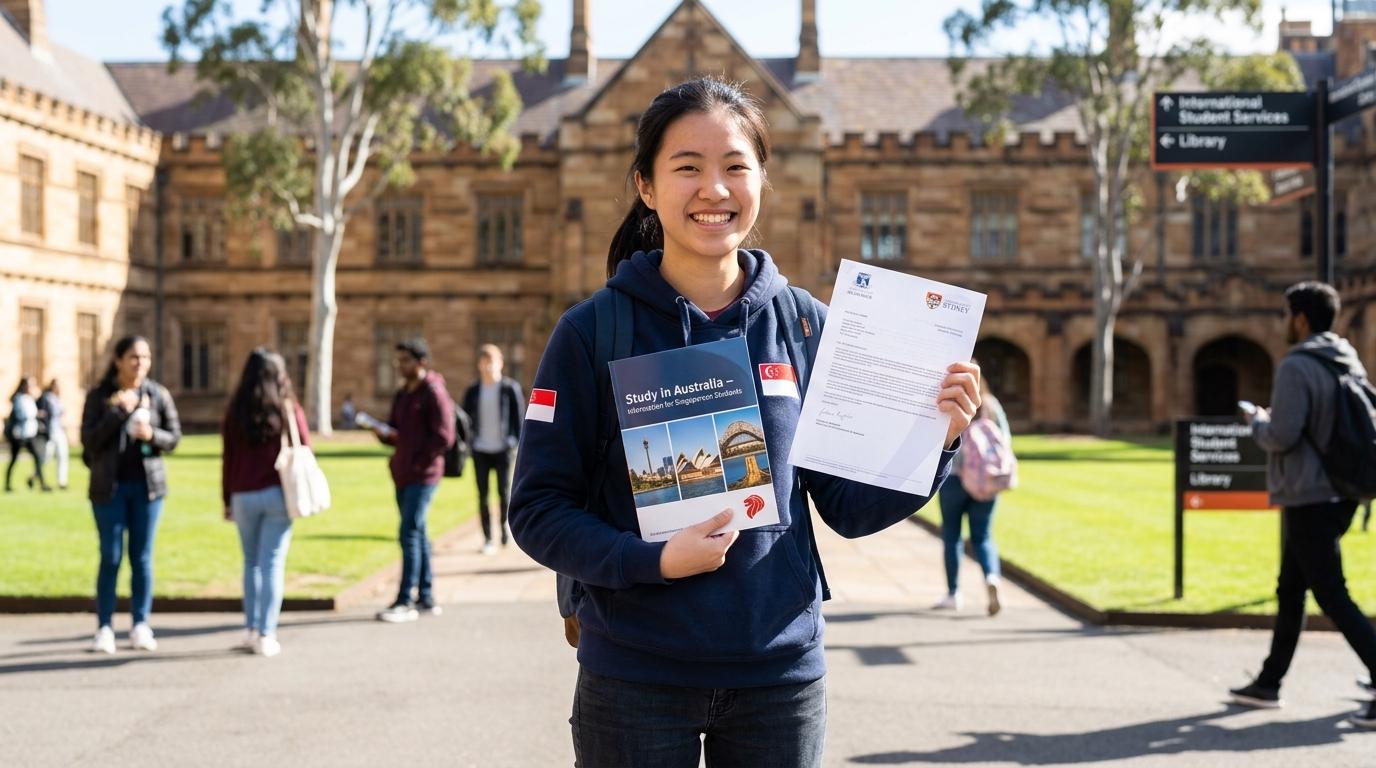
Planning to study abroad is exciting. But without a clear roadmap, it can quickly become overwhelming.
Between shortlisting universities, understanding qualification requirements, preparing applications, and sorting visas — there's a lot more to manage than most Singapore students and parents initially expect.
This guide is built specifically for Singapore students who want to study in australia for singapore student success — covering everything from the earliest planning stages right through to pre-departure preparation.
Start With the Right Mindset
Before diving into rankings and application portals, get one thing clear: studying in Australia is not just a backup plan for students who didn't get into NUS or NTU.
It's a deliberate, strategic choice — one that offers world-class education, genuine post-study work rights, and a completely different kind of personal growth.
Students who approach it that way consistently get more out of the experience than those who treat it as a consolation prize.
Step 1 — Clarify Your Goals Before You Shortlist Anything
The biggest planning mistake students make is jumping straight to university rankings without first asking:
-
What do I actually want to study — and why?
-
What kind of career am I working toward?
-
Do I want to stay in Australia after graduation or return to Singapore?
-
What's my family's realistic budget for four years of overseas education?
-
Do I prefer a large city campus or a smaller, quieter university environment?
Your answers to these questions should drive every decision that follows — from which universities you target to which city you choose to live in.
Step 2 — Understand How Your Singapore Qualifications Are Assessed
This step is non-negotiable and often skipped. Different Australian universities assess Singapore qualifications in different ways.
A-Level students — Your H1 and H2 subject results are typically converted into an ATAR equivalent. The conversion method varies by university, and some are significantly more generous than others for the same grade profile.
IB Diploma students — Well-recognised across Australian universities. Your total IB points generally map cleanly to entry requirements.
Polytechnic diploma holders — Direct entry is possible at many universities, and advanced standing (entry into Year 2) is available at several institutions depending on your diploma.
O-Level students — Typically enter via a Foundation Programme or Diploma pathway before progressing to a Bachelor's degree.
Getting this assessment right before you apply is critical. Applying to a course you're not eligible for wastes time, money, and opportunity.
Step 3 — Build Your University Shortlist Strategically
A well-built shortlist has three tiers:
|
Tier |
Description |
Number of Universities |
|
Reach |
Highly competitive, your profile is borderline |
1–2 |
|
Target |
Strong fit, realistic chance of offer |
2–3 |
|
Safety |
High likelihood of offer, still a good outcome |
1–2 |
Don't apply to only reach universities — and don't apply to only safe ones either. A balanced shortlist protects you while still aiming high.
Also consider: location, campus culture, industry connections, scholarship availability, and post-graduation employment outcomes for your specific course.
Step 4 — Know the Real Costs and Plan Accordingly
Let's talk numbers. Families who plan around accurate figures avoid nasty surprises mid-degree.
Approximate Annual Tuition (International Students):
|
Course |
Annual Tuition (AUD) |
|
Arts / Social Sciences |
AUD 20,000 – 33,000 |
|
Business / Commerce |
AUD 26,000 – 40,000 |
|
Engineering / IT |
AUD 30,000 – 45,000 |
|
Medicine / Dentistry |
AUD 60,000 – 90,000 |
Living Costs: Budget AUD 20,000 – 25,000 per year. Sydney and Melbourne sit at the higher end; Adelaide and Perth are more affordable.
Scholarship Tip: Many Australian universities offer merit scholarships to international students covering 25% to 100% of tuition. These have earlier deadlines than the main application — often by two to three months. Missing them is one of the most common and costly mistakes Singapore students make.
Step 5 — Prepare for Standardised Testing Early
Some Australian universities and merit scholarship programmes accept or encourage SAT or ACT scores from international applicants — particularly for competitive programmes or holistic scholarship assessments.
If your academic results are strong but not exceptional, a solid ACT Test Preparation score can meaningfully strengthen your overall application profile.
Check your target universities' scholarship criteria specifically — this is where standardised test scores are most likely to carry weight.
Step 6 — Build a Strong Application
This is where most students either win or lose ground — not in their grades, but in how they present themselves.
A strong application to an Australian university typically includes:
-
Academic transcripts — Certified copies, translated if necessary
-
Personal statement — Your most important document. It should tell a coherent story, not just list achievements
-
Referee letters — From teachers or mentors who can speak specifically to your academic and personal strengths
-
Standardised test scores — Where applicable
-
Portfolio — Required for creative arts, architecture, and some design programmes
For students who need structured preparation support across all of these elements, Online Test Prep at The Princeton Review Singapore offers comprehensive programmes that support both academic readiness and admissions preparation.
Mini Student Case Study
Student Profile: Wei Jie, 18, Singapore JC student, A-Level predicted grades — ABB
Wei Jie wanted to study Engineering at a Go8 university but was worried his predicted grades weren't competitive enough.
His consultant identified that the University of Adelaide's Engineering programme had a slightly lower cut-off for international applicants with A-Level qualifications — and that a merit scholarship was available with a separate deadline three months before the main application.
Wei Jie submitted his scholarship application first, with a carefully prepared personal statement that highlighted his robotics competition wins and school leadership roles.
He received both an offer and a partial scholarship covering 30% of his first-year tuition.
The strategy — not the grades — made the difference.
Australia University Application Timeline for Singapore Students
|
Timeline Before Intake |
Action |
|
18 months |
Research universities and courses, assess qualification fit |
|
15 months |
Attend education fairs and consultancy sessions |
|
12 months |
Finalise shortlist, begin personal statement drafts |
|
10 months |
Start standardised test preparation if required |
|
8 months |
Submit scholarship applications |
|
6 months |
Submit university applications |
|
4 months |
Accept offer, begin student visa application |
|
2 months |
Arrange accommodation, OSHC, pre-departure admin |
|
1 month |
Confirm orientation registration, organise finances |
Australia has two main intakes — February/March and July. Plan your timeline backwards from your target intake.
Common Planning Mistakes to Avoid
-
Starting too late — 18 months is ideal; six months is stressful and limits your options
-
Applying to too few universities — A shortlist of one or two is a risk strategy, not a plan
-
Ignoring scholarship deadlines — These are almost always earlier than application deadlines
-
Treating the personal statement as an afterthought — It can be the deciding factor in competitive applications
-
Not accounting for the full cost of living — Tuition alone is only half the financial picture
-
Skipping the visa timeline — Student visa processing takes four to eight weeks; don't leave it late
Pro Tips From Admission Experts
Here's what experienced consultants consistently tell Singapore students planning to study in Australia for singapore student success:
-
Research the graduate employment rate for your specific course — Not just the university's overall ranking
-
Visit the university's international student portal directly — Information there is more accurate than third-party rankings sites
-
Connect with current Singapore students at your target universities — LinkedIn and university Facebook groups are excellent for this
-
Understand the credit transfer policy before you apply — Especially important for Poly diploma holders
-
Keep every document organised from day one — Transcripts, test scores, financial records, visa correspondence
FAQ
Q: How many Australian universities should I apply to? Most advisors recommend four to six universities across reach, target, and safety tiers. This gives you real choice when offers arrive.
Q: Can I apply to multiple intakes in the same year? Yes. Many students apply for both February and July intakes simultaneously, particularly if they're waiting on A-Level or IB results.
Q: Is the Group of Eight the only option worth considering? Not at all. For many courses — particularly applied, vocational, or industry-linked programmes — universities like UTS, Curtin, RMIT, and Griffith offer excellent outcomes and stronger industry connections in specific fields.
Q: How competitive are merit scholarships for Singapore students? Very competitive — but Singapore students are well-regarded by Australian universities. A strong academic record combined with a compelling personal statement gives you a genuine shot.
Q: Do I need a consultant to follow this planning guide? You can use this guide independently, but a good consultant adds value by customising the strategy to your specific profile, qualifications, and goals — and by catching mistakes before they cost you an opportunity.
Conclusion
The students who succeed in Australia aren't always the ones with the highest grades. They're the ones who planned with intention, prepared with care, and made decisions based on accurate information rather than assumptions.
Whether you're in Secondary 4, finishing JC, or completing a Polytechnic diploma — the best time to start planning is now. Every month of preparation you invest makes the process smoother, the applications stronger, and the outcomes better.
Build your plan. Follow your timeline. And give yourself the best possible chance.

 English
 Arabic
 Spanish
 Portuguese
 Deutsch
 Turkish
 Dutch
Dutch
 Italiano
 Russian
 Romaian
 Portuguese (Brazil)
 Greek
Greek