


Reverse Engineering Your Goals: The Strategic Life Lesson Hidden Inside a Debut Espionage Novel
Introduction
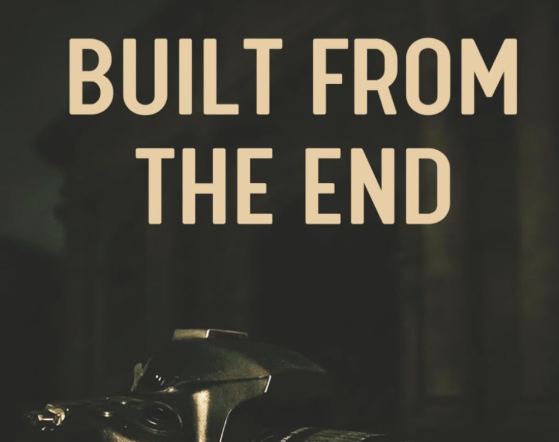
The most useful piece of strategic advice in business literature is hiding inside a thriller novel. It arrives in the second chapter of Built from the End, Courtney Murchie's debut novel, delivered by a contract killer's father over a chess board in a rented cabin above a frozen Austrian lake. The advice is this: stop playing from the middle. Start at the end. Picture how you want it to finish, then build everything backwards from there.
The novel's protagonist, Isla Vranic, is a Caltech-educated chemist who takes contracts to eliminate high-value European targets through engineered, untraceable deaths. That operational context is extreme. The methodology is not. It is a rigorous application of backward induction, the same cognitive framework that underlies Amazon's working-backwards product development process, Gary Klein's pre-mortem technique, and the planning methods used by military commanders for complex, high-dependency operations.
Why Forward Planning Is a Cognitive Trap
Forward planning is intuitive. You start from where you are, project a desired outcome, and map the steps between. It mimics the way time moves. It also mimics the way optimism works, which is its central failure mode.
When you plan forward, you imagine the future primarily by extrapolating from your current situation. The assumptions embedded in that extrapolation tend to be invisible. You assume that resources available now will remain available. You assume that the obstacles you can currently conceive are representative of the ones you will actually face. You assume that conditions at step seven will resemble conditions at step one. None of these assumptions are reliable for complex, long-duration goals.
The result is plans that are coherent at their origin and increasingly fragile as distance from that origin grows. Execution reveals dependencies that planning never surfaced. This is not a failure of effort. It is a structural feature of forward reasoning.
Backward Induction: The Mechanism
Backward induction starts with the end state, described with as much specificity as possible, and asks a single question: what would have to be true immediately before this outcome for it to occur? The answer generates the second-to-last state. Repeat the question. Map the entire sequence in reverse until you arrive at the first required action, the step you can take today.
The method forces two things that planning avoids. First, it requires you to define the end state with actual precision before you begin. Vague goals cannot be backward-engineered. The discipline of defining done with clarity is itself a significant portion of the work. Second, it surfaces dependencies in the correct order. If step six requires a condition that step three prevents from occurring, backward planning reveals that conflict before any resources are committed. Planning discovers it during execution.
Murchie shows this method in forensic detail across every mission sequence in the novel. Buy Built from the End at Amazon to read the full operational methodology in narrative form.

The Amazon Working-Backwards Parallel
Amazon's product development process begins with an internal press release.
Before a single engineer writes a line of code, a team writes the announcement of the finished product as it will appear to customers on the day it ships. The press release includes what the product does, why customers care, and what problem it solves. Every subsequent development decision is evaluated against that document.
The logic is identical to Isla's chess method. You define the conclusion with precision. You build backwards to the first step. Every choice between now and then is evaluated by whether it serves the conclusion you have already written. The Amazon press release is Isla's end-state whiteboard. The development process is the reverse-mapped sequence of moves.
The pre-mortem technique, developed by research psychologist Gary Klein, uses the same inversion. A team is asked to imagine that a project has already failed, completely and definitively, and to work backwards to identify what caused that failure. This forward-in-time assumption of failure forces the brain to generate a different class of risks than planning produces. Problems that were invisible become obvious the moment you start from the endpoint.
How to Apply This to Non-Lethal Decisions
The method transfers directly to ordinary strategic decisions. A career change, a product launch, a financial independence target, a health goal with a specific quantitative outcome: all of them can be backward-engineered using the same structure.
Start by writing the end state with specificity. Not a goal, but a scene. What does done look like, described in observable, measurable terms? Who is present? What has already happened? What does the evidence of success actually consist of? Then ask: what is the last decision or event that precedes this outcome? And the one before that? Keep mapping backward until you reach a first step that requires no prior conditions you do not currently control.
That first step is your entry point. Everything between it and the end state is your plan. It was built from the end, which means every step in it was chosen because it is genuinely required by the conclusion, not because it felt like reasonable progress from wherever you happened to start.
For the author's perspective on this framework and its origins in the novel, visit Courtney Murchie's official website.
Conclusion
The novel makes no claim to be a business book. It is a tightly constructed espionage thriller with a protagonist worth admiring and an antagonist worth fearing. But the thinking method at its center is genuinely useful, practically applicable, and drawn from real strategic frameworks that have been validated across military planning, technology development, and cognitive research. The chess lesson from a frozen cabin above Lake Zell is the most transferable skill in the book. Start at the end. Build backwards. Make the outcome inevitable before you move the first piece.

 English
 Arabic
 French
 Spanish
 Portuguese
 Deutsch
 Turkish
 Dutch
Dutch
 Italiano
 Russian
 Romaian
 Portuguese (Brazil)