


10 Benefits of Choose Birmingham City University as an Indian Students
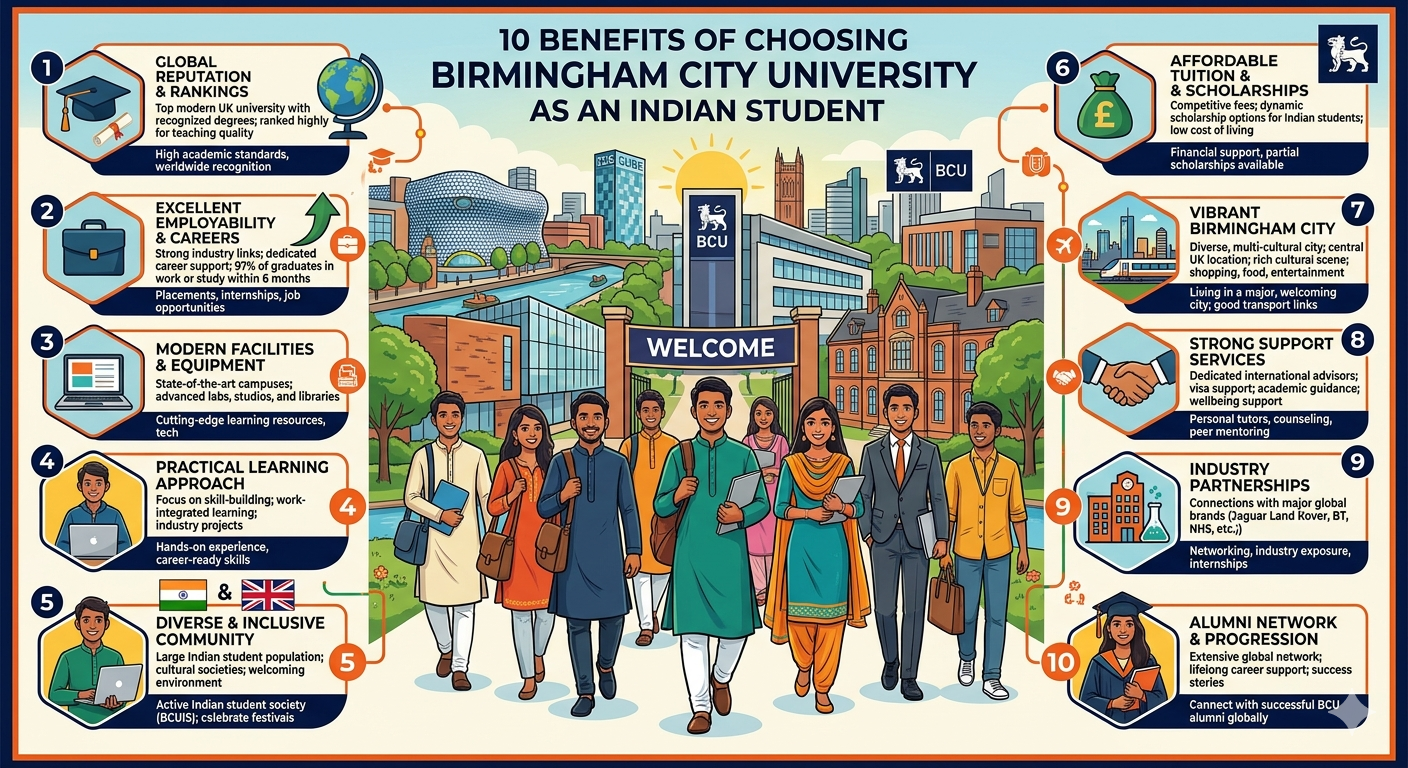
Let me start with something most consultants won't tell you. When Indian students come to us with a list of UK universities, the names are almost always predictable: Manchester, Leeds, Nottingham, Warwick. And those are fine universities. But Birmingham City University almost never makes that first draft of the list. And that's a mistake.
After sending hundreds of Indian students to the UK over the last decade, we've watched BCU quietly become one of the most reliable, student-friendly options for Indian applicants. Not because it's the most famous. Because it actually works for the specific constraints Indian students face—budgets, visa requirements, part-time work needs, and the very real pressure of getting a job afterward.
Let me give you ten concrete reasons why.
Why to Choose Birmingham City University In UK
1. The Birmingham City University Acceptance Rate Works in Your Favour
Let's talk numbers honestly. The Birmingham City University acceptance rate hovers around 65-70% for most postgraduate programs. For undergraduate courses, it varies between 55-65% depending on the department.
Here's what that means for you as an Indian student. When you apply to BCU, you aren't entering a lottery. You aren't competing against 2,000 other applicants for 50 seats. The admissions team actually reads your application. They consider your marks in context—whether you're from CBSE, ICSE, or a state board. They understand that a 60% from Mumbai University might represent real achievement even if it doesn't translate directly to a UK first-class degree.
We've had students with IELTS scores of 6.0 (not 6.5, not 7.0) receive conditional offers with a pre-sessional English course attached. That's flexibility. That's the difference between going to the UK and staying home another year.
2. Birmingham Is India's Most Familiar British City
This sounds trivial. It's not.
Birmingham has one of the largest Indian diaspora populations in the UK. You'll find Punjabi sweet shops in Handsworth. Tamil grocery stores in Selly Oak. Gujarati snacks in Sparkbrook. More importantly, you'll find people who understand your frame of reference—parents who worry about arranged marriages, students who celebrate Diwali properly, temple communities that actually function.
When you're 4,500 miles from home and feeling the weight of February in the UK—the grey skies, the early darkness, the quiet streets—being able to walk into a shop where someone greets you in Hindi or Punjabi is not a small comfort. It's a lifeline.
3. Tuition Fees That Don't Require Selling a Kidney
Let me be direct. UK university fees have gone insane. Some London universities now charge international students £28,000-£35,000 per year just for tuition. That's before rent, before food, before travel.
BCU's international fees sit between £14,000 and £17,000 for most courses. Some programs go higher—their MBA or certain engineering master's—but the vast majority stay under £16,000.
For an Indian family earning ₹15-20 lakhs annually, that difference is enormous. That's the difference between taking one education loan versus two. Between involving one set of grandparents versus begging relatives. Between actually affording the degree versus drowning in EMIs for a decade.
We tell students: don't borrow money for a brand name. Borrow money for a degree that pays back. BCU's fee structure keeps the payback period realistic.
4. The Scholarship Situation Is Actually Real
Many UK universities advertise scholarships that 0.5% of international students actually receive. BCU runs different math.
Their BCU International Scholarship offers automatic consideration—no separate essay, no three rounds of interviews. If you have a first-class equivalent degree, you get £2,000-£3,000 off tuition. That's not life-changing, but it's a semester's rent. It's three months of groceries.
They also run country-specific scholarships for Indian students. The India Scholarship, last we checked, knocked another £1,500 off for students from certain partner institutions. And unlike most scholarships, you don't have to repay it if your grades drop. It's a discount, not a conditional loan.
5. Two-Year Degree Structure That Saves You an Entire Year
Here's something Indian students consistently undervalue. Most UK master's degrees run one year. Most UK undergraduate degrees run three years. BCU runs accelerated undergraduate programs in business, law, and computing that finish in two years.
Think about that timeline. Your friends from school go to India for a three-year B.Com or B.Sc. You go to BCU for a two-year BA in Business Management. You graduate the same year they do, except you have a UK degree, you've lived abroad, and you've already used the Graduate Route visa's two-year work period while they're just starting their first job in India.
That's not academic. That's arithmetic. Two years versus three. That's 12 months of additional earnings and experience.
6. The Birmingham City University Acceptance Rate Lets You Apply Late
Most Indian students don't decide to study abroad in October of their final year. They decide in March, after entrance exam results disappoint, after a relationship changes, after a family conversation shifts priorities.
By March, most Russell Group universities have closed applications. BCU hasn't. Their rolling admissions process means you can apply as late as June or even July for September intake. The Birmingham City University acceptance rate stays consistent throughout the cycle—they don't fill quotas early and reject late applicants just because.
We've placed students who called us in May, panicking about a failed CAT or a missed CLAT deadline, into BCU programs starting that September. That flexibility is not common. Don't take it for granted.
7. Industry Connections That Actually Hire Indian Graduates
BCU sits in the heart of the West Midlands—the UK's second-largest regional economy. Jaguar Land Rover's headquarters is ten minutes from campus. The HS2 rail project's engineering hub is nearby. Birmingham's financial services sector employs 100,000+ people.
More relevant to you: these employers are used to hiring Indian graduates. They understand your visa situation. They know the Graduate Route rules. They've sponsored Tier 2 visas before. That institutional familiarity matters.
We've seen BCU graduates from the MSc in Data Networks and Security get hired by BT and Ericsson. Law graduates find paralegal roles in Birmingham's mid-sized firms. Business graduates walk into graduate schemes at HSBC and PwC's Birmingham offices. Not all of them. But enough that the pipeline is real.
8. Living Costs That Don't Make London Look Reasonable
London students pay £900-£1,200 per month for a room in a shared flat. Birmingham students pay £500-£700. That's not a small difference. That's £400-£500 monthly. Over a one-year master's, that's £5,000-£6,000 saved.
Here's actual current pricing: a room in BCU's The Maltings or The Coppice accommodation runs £115-£150 per week, bills included. Private rentals in Selly Oak or Harborne run £80-£100 per week plus bills. Compare that to London's £250-£350 per week.
For an Indian student on a budget, that difference determines whether you eat home-cooked meals or skip meals. Whether you can afford the occasional train trip to London or stay in your room. Whether you finish your degree mentally healthy or burnt out and broke.
9. The Indian Student Community Is Organized, Not Just Present
Many UK universities have Indian student societies that plan three events per year and then disappear. BCU's Indian Society runs weekly events. Diwali celebrations that actually fill a hall. Holi on the main quad. Cricket matches against the Pakistani Society (friendly, mostly).
More practically, the society maintains a WhatsApp group where older students advise newer ones—which SIM card works best, which GP surgery actually answers the phone, which part-time job agencies don't exploit students. That information is gold. You cannot find it on a university website. You only get it from students who learned the hard way.
10. The Graduate Route Visa Math Works Out Better Here
Let me give you the calculation we run with every Indian student.
You graduate from BCU with a master's in September. You have two years on the Graduate Route visa. Birmingham's cost of living is low enough that you can survive on a part-time or entry-level salary while looking for sponsored work. In London, that same salary wouldn't cover rent. You'd be forced to take any job, not the right job.
Because you're in Birmingham, you can wait. You can be selective. You can take three months to find the right paralegal role, the right junior developer position, the right graduate scheme. That patience pays off. We've seen BCU graduates secure Tier 2 (now Skilled Worker) visa sponsorships at month 18, month 20, even month 22 of their Graduate Route—because they could afford to keep looking.
In London, they'd have run out of money by month 8.
One Honest Closing Note
We don't tell Indian students to choose Birmingham City University because we get a commission. We get the same commission from every UK university. We tell you to consider BCU because it fits a specific profile: you have decent but not exceptional marks, you need realistic entry requirements, you want a genuine British experience without bankrupting your family, and you understand that a degree is an investment, not a status symbol.
Check the Birmingham City University acceptance rate for your specific course. Talk to current Indian students there. Calculate the total cost including living expenses. And then make your decision with open eyes.
BCU won't impress your relatives at the wedding reception. But it might just get you the job that lets you pay for that reception yourself.

 Arabic
 French
 Spanish
 Portuguese
 Deutsch
 Turkish
 Dutch
Dutch
 Italiano
 Russian
 Romaian
 Portuguese (Brazil)
 Greek
Greek