


USA Mental Health Provider Billing Strategies That Improve Reimbursements and Reduce Claim Delays
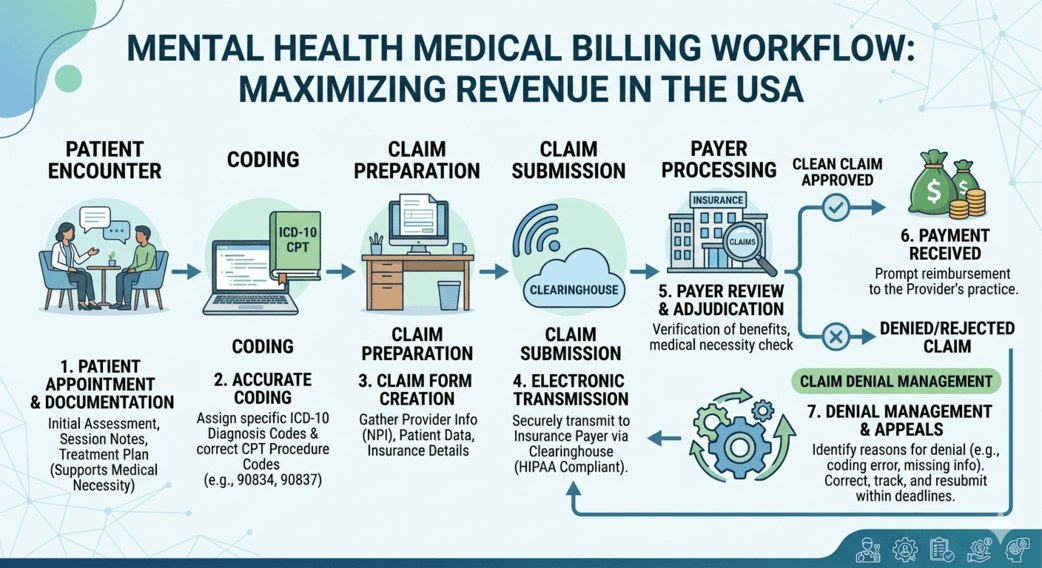
Mental health practices across the USA are facing growing administrative pressure. From changing payer requirements to complex documentation standards, providers are spending more time handling billing issues instead of focusing on patient care. Whether it’s a solo therapist, psychiatric clinic, or multi-location behavioral health center, effective mental health provider billing has become essential for financial stability.
Unlike many other specialties, mental health billing involves unique coding structures, session-based claims, telehealth compliance, authorization tracking, and evolving insurance regulations. Even small errors in documentation or coding can lead to delayed reimbursements, denied claims, or compliance concerns.
As demand for behavioral health services continues to rise, practices are realizing that strong billing systems are not optional anymore. They are a core part of sustainable healthcare operations.
Why Mental Health Billing Requires Specialized Expertise
Mental health claims are rarely straightforward. Insurance carriers often apply strict rules for therapy sessions, medication management, intensive outpatient programs, and telepsychiatry services.
Providers frequently deal with:
- Time-based CPT coding
- Prior authorization requirements
- Frequent policy updates
- Coverage limitations
- Modifier confusion
- Telehealth documentation standards
- Coordination of benefits issues
A general billing process may not fully address these specialty-specific challenges. That is why many providers now partner with specialized mental health billing teams that understand payer expectations and behavioral health workflows.
For example, a psychiatric clinic handling both medication management and psychotherapy services may face claim denials if session durations are improperly documented. Similarly, teletherapy practices must follow payer-specific virtual care rules to avoid reimbursement delays.
Common Billing Challenges Mental Health Providers Face
1. Claim Denials Due to Documentation Gaps
Mental health services require highly detailed clinical documentation. Missing treatment plans, incomplete progress notes, or inaccurate diagnosis coding can trigger denials quickly.
Insurance companies often review:
- Session duration
- Medical necessity
- Treatment goals
- Patient progress
- Provider credentials
Without proper alignment between clinical notes and billing codes, practices may struggle with recurring rejections.
2. Complex Coding Requirements
Behavioral health coding changes regularly. Providers must stay updated with CPT, ICD-10, and HCPCS changes while also understanding payer-specific coding preferences.
This is where accurate medical coding services become critical. Correct coding not only improves claim approval rates but also protects practices during audits.
3. Credentialing Delays
Many mental health professionals experience delayed enrollments with insurance networks. Slow credentialing can postpone reimbursements for months.
Efficient credentialing services help providers:
- Complete payer enrollment faster
- Avoid application errors
- Maintain active contracts
- Track renewals and revalidations
Without proper credentialing support, even high-volume practices can lose significant revenue opportunities.
4. Telehealth Billing Complications
Since virtual therapy expanded nationwide, telehealth billing regulations continue to evolve. Different states and payers may require unique modifiers, POS codes, or documentation standards.
Mental health providers must ensure compliance with both federal and commercial insurance requirements to receive accurate payments.
The Growing Demand for Regional Mental Health Billing Support
Many providers prefer billing teams familiar with local payer behavior and regional healthcare trends. This has increased interest in specialized billing support across multiple states.
Practices searching for mental health billing agency Delaware support often need assistance navigating regional Medicaid requirements and payer credentialing processes. Similarly, providers seeking a mental health billing company Georgia frequently prioritize behavioral health expertise combined with fast denial resolution.
Across the country, demand continues growing for:
- mental health billing services Arizona
- mental health billing services Cary
- mental health billing services company Delaware
- mental health billing services company Georgia
- mental health billing services Connecticut
- mental health billing services Illinois
- mental health billing services North Carolina
- mental health billing services Ohio
- mental health billing services Rhode Island
- mental health billing services Tennessee
- mental health billing services Texas
- mental health billing services Virginia
- mental health billing Toledo Ohio
Each region presents unique payer patterns, reimbursement timelines, and compliance expectations. Providers benefit when billing teams understand these local challenges instead of using a one-size-fits-all approach.
How Revenue Cycle Management Improves Mental Health Practice Stability
Revenue issues in behavioral health often begin long before claim submission. Strong revenue cycle management services help practices control the full financial workflow from patient registration to final payment posting.
An effective revenue cycle strategy includes:
Insurance Verification
Verifying eligibility before appointments reduces claim denials related to inactive coverage or authorization problems.
Accurate Charge Capture
Every therapy session, psychiatric evaluation, and medication management visit must be documented and billed correctly.
Denial Management
Denied claims should never sit unresolved. Quick follow-up improves cash flow and reduces aging accounts receivable.
Payment Posting and Reporting
Detailed reporting helps providers identify patterns such as:
- Frequently denied CPT codes
- Slow-paying insurance carriers
- Authorization-related revenue loss
- Underpaid claims
Behavioral health organizations that invest in structured revenue cycle management services typically experience faster reimbursements and stronger financial forecasting.
Why Mental Health Providers Are Outsourcing Billing Operations
Outsourcing has become increasingly common among mental health practices of all sizes.
Instead of hiring and training large in-house teams, providers often choose external billing specialists who already understand behavioral health regulations.
Key Benefits of Outsourcing
Reduced Administrative Burden
Providers spend less time dealing with payer calls, appeals, and coding updates.
Better Claim Accuracy
Experienced billing professionals reduce coding errors and documentation inconsistencies.
Improved Collections
Faster claim processing usually leads to healthier monthly cash flow.
Access to Industry Expertise
Dedicated behavioral health billing specialists stay updated with payer policy changes and compliance requirements.
For growing practices, outsourcing also eliminates the stress of scaling internal billing departments during expansion.
The Role of Medical Billing and Coding Services in Behavioral Health
Mental health providers rely heavily on accurate coding because reimbursement depends on precise service classification.
Professional medical billing and coding services help practices:
- Apply correct CPT and ICD-10 codes
- Prevent duplicate billing errors
- Reduce rejected claims
- Maintain compliance standards
- Improve reimbursement timelines
Coding mistakes can create serious financial consequences. For example, incorrectly billing psychotherapy add-on codes or medication management sessions may lead to audits or payer investigations.
Strong coding accuracy protects both revenue and compliance.
Real-World Example: How Billing Optimization Increased Revenue
A multi-provider counseling practice in the USA struggled with growing claim denials and inconsistent collections. Their internal staff had difficulty keeping up with payer requirements, authorization renewals, and telehealth coding updates.
After implementing structured medical billing services and specialized behavioral health coding support, the practice improved several key areas:
- Reduced claim denial rates
- Faster payment turnaround
- Improved authorization tracking
- Better reporting visibility
- Increased monthly collections
The providers were able to spend more time focusing on patient care instead of administrative issues.
This example reflects a common reality in today’s behavioral healthcare environment. Financial performance often improves when billing systems become more specialized and proactive.
Compliance Matters More Than Ever in Mental Health Billing
Behavioral health practices handle highly sensitive patient data while navigating strict payer regulations.
Providers must maintain compliance with:
- HIPAA requirements
- Telehealth regulations
- Insurance documentation standards
- State-specific behavioral health rules
- Audit preparedness protocols
Even unintentional billing mistakes can trigger compliance reviews. This is why many organizations prioritize experienced billing partners with behavioral health expertise.
Accurate documentation, secure claim processing, and transparent reporting all play major roles in protecting mental health practices from financial and legal risks.
Technology Is Changing Mental Health Billing
Modern billing systems are helping behavioral health organizations improve operational efficiency.
Today’s billing platforms often include:
- Automated eligibility verification
- Electronic claim submission
- Real-time denial tracking
- Integrated EHR workflows
- Financial analytics dashboards
Technology also supports faster communication between providers, billing teams, and insurance carriers.
However, software alone is not enough. Successful outcomes still depend on experienced professionals who understand payer behavior, coding rules, and mental health reimbursement structures.
Supporting Practice Growth Through Better Billing Operations
As mental health awareness continues growing nationwide, many practices are expanding rapidly. New patient demand creates opportunities, but it also increases administrative complexity.
Scaling a practice successfully requires strong operational systems behind the scenes.
This includes:
- Efficient appointment workflows
- Timely claim submission
- Accurate coding processes
- Credentialing management
- Financial reporting transparency
Practices that ignore billing inefficiencies often experience revenue leakage despite high patient volume.
Strong medical billing and coding services help create a stable financial foundation that supports long-term growth.
How 247 Medical Billing Services Supports Behavioral Health Providers
Many mental health organizations now seek specialized support from experienced billing partners like 247 Medical Billing Services. Behavioral health practices require more than basic claim submission. They need teams that understand psychiatric billing regulations, therapy coding structures, denial management, and payer compliance expectations.
Comprehensive support may include:
- Medical billing services for behavioral health claims
- Medical coding services for accurate CPT and ICD-10 reporting
- Revenue cycle management services for end-to-end financial optimization
- Credentialing services for payer enrollment and maintenance
- Denial resolution and appeals management
- Telehealth billing compliance support
With behavioral healthcare evolving rapidly across the USA, specialized billing expertise can significantly improve operational efficiency and reimbursement performance.
Conclusion
Mental health provider billing is far more complex than standard claim processing. From documentation accuracy to payer compliance and telehealth regulations, behavioral health organizations face unique administrative challenges every day.
Practices that invest in specialized billing strategies often see measurable improvements in reimbursement speed, claim acceptance rates, and financial stability.
Whether providers are searching for mental health billing services Texas, mental health billing services Virginia, mental health billing services Ohio, or regional behavioral health billing support elsewhere in the USA, the goal remains the same: reducing administrative stress while improving revenue performance.
Reliable billing systems, accurate coding, proactive denial management, and efficient credentialing processes are now essential for sustainable growth in behavioral healthcare.
As the industry continues evolving, practices that strengthen their billing operations today will be better positioned to deliver quality patient care tomorrow.
Frequently Asked Questions
1. What makes mental health provider billing different from other medical specialties?
Mental health billing involves time-based therapy coding, telehealth regulations, authorization requirements, and highly detailed documentation standards. These factors make behavioral health billing more specialized than many other medical fields.
2. Why do mental health claims get denied frequently?
Common reasons include incorrect CPT codes, incomplete documentation, missing authorizations, credentialing issues, and payer-specific compliance errors.
3. How can revenue cycle management services help mental health practices?
Revenue cycle management services improve claim accuracy, reduce denials, speed up reimbursements, and provide better financial visibility for behavioral health organizations.
4. Are credentialing services important for mental health providers?
Yes. Credentialing services help providers enroll with insurance networks, maintain active payer contracts, and avoid reimbursement delays caused by incomplete applications or expired credentials.
5. What role do medical coding services play in behavioral health billing?
Medical coding services ensure therapy sessions, psychiatric evaluations, and related services are coded accurately according to payer guidelines and compliance standards.
6. Should small therapy practices outsource medical billing services?
Many small and mid-sized practices outsource billing to reduce administrative workload, improve collections, and gain access to behavioral health billing expertise without hiring large internal teams.

 English
 Arabic
 French
 Spanish
 Portuguese
 Turkish
 Dutch
Dutch
 Italiano
 Russian
 Romaian
 Portuguese (Brazil)
 Greek
Greek